
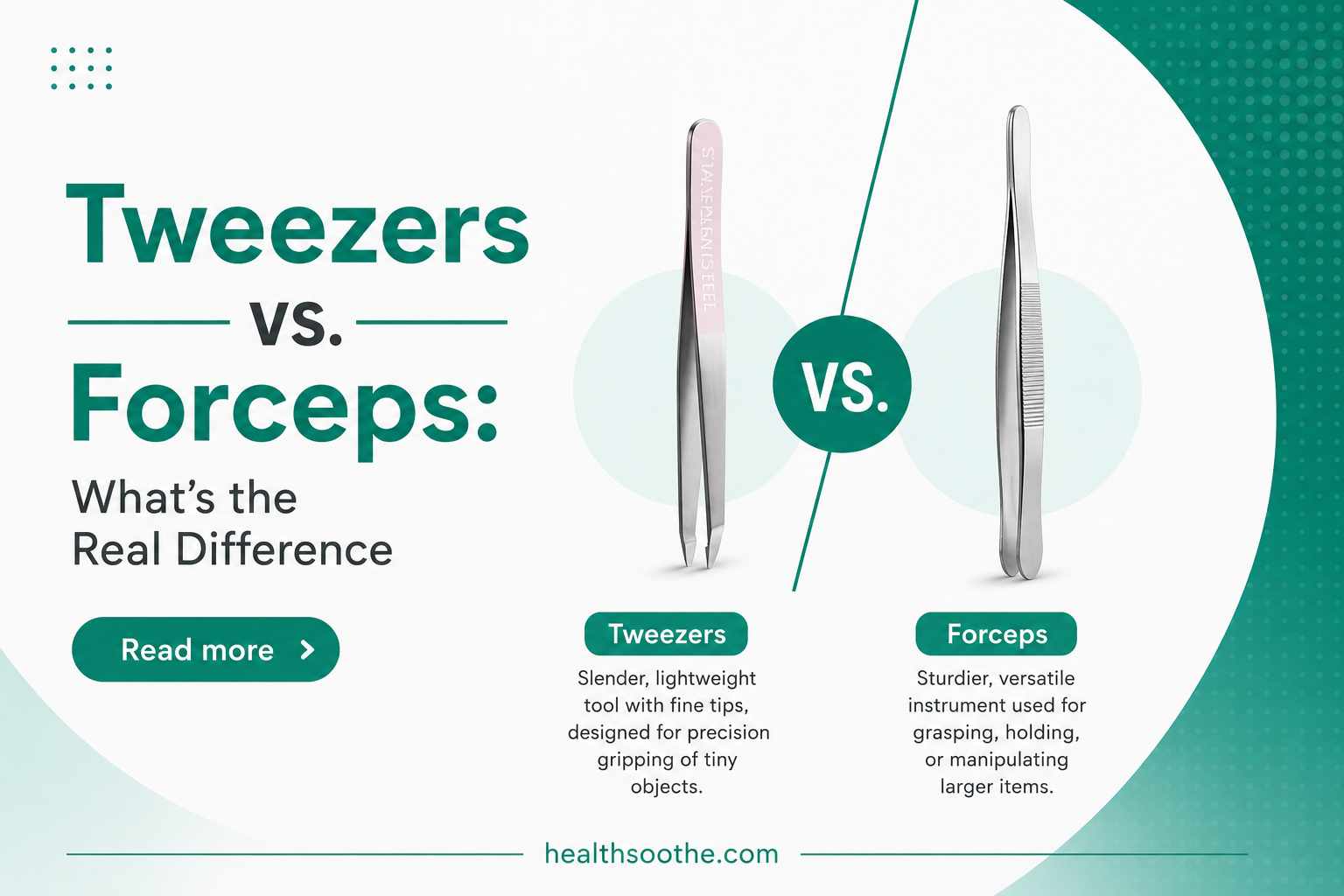
Walk into an operating room, a dental office, or even a first-aid kit, and you will find tools that look almost identical but do very different jobs. Tweezers and forceps fall into that category. People use the words interchangeably all the time, but anyone who has worked with surgical instruments knows they are built differently and used for different reasons.
Here is a plain breakdown of what separates the two, how each one is used, and which one fits which kind of task.
What Are Surgical Tweezers?
Surgical tweezers, also called thumb forceps or dissecting forceps, are two thin arms joined at one end, with no hinge and no lock. You hold them like a pencil, pinching the arms together between your thumb and fingers. As soon as you let go, the grip releases. There is no ratchet holding anything in place, which means the amount of pressure applied depends entirely on the user’s hand.
Because they respond instantly to hand pressure, tweezers are the go-to tool whenever a job calls for light, fast, repeated movements rather than a firm, sustained hold. Common uses include:
- Picking up and repositioning small pieces of tissue during dissection
- Holding skin edges steady while a wound or incision is sutured
- Handling gauze, sterile dressings, or small medical supplies
- Pulling splinters or small foreign objects out of the skin
- Guiding suture thread into place while tying a knot
You will see tweezers used most often in eye surgery, plastic surgery, dermatology, neurosurgery, and any procedure where the surgeon needs to feel exactly how much pressure they are applying. That direct feedback is the main reason surgeons reach for tweezers over forceps when working on something delicate. Common types include Adson tweezers, jeweler’s tweezers, Bishop tweezers, Castroviejo tweezers, and Semken tweezers, each shaped for a different level of precision.
What Are Forceps?
Forceps work more like a pair of scissors. Two blades cross in the middle on a hinge, and finger rings on the handle let you open and close them with one hand. Most forceps also have a ratchet near the handle that locks the jaws shut, so once you clamp down on something, it stays clamped, no matter how long the procedure takes or what else your hands are doing.
That locking feature is what sets forceps apart, and it’s why they get used for jobs that need a hold that won’t slip. Common uses include:
- Clamping a blood vessel shut to stop bleeding
- Holding tissue or an organ out of the way so the surgeon has a clear view
- Pulling a foreign object out of a wound or deep tissue
- Gripping and guiding a suture needle through tissue
- Taking hold of a tissue sample for a biopsy
Forceps show up across nearly every surgical specialty: general surgery, cardiothoracic surgery, OB/GYN, and orthopedics. Familiar names include Kelly forceps, mosquito artery forceps, Crile hemostatic forceps, Babcock tissue forceps, and Rochester-Ochsner forceps. Each one is sized and shaped for a specific kind of tissue or vessel, but they all share the same basic locking design.
Tweezers vs. Forceps: Side by Side
Here is a quick comparison to keep the differences straight.
| Feature | Tweezers | Forceps |
|---|---|---|
| Basic design | Two arms joined at one end | Two hinged blades that cross in the middle |
| Locking mechanism | None | Ratchet lock on most models |
| How you hold it | Pinched between thumb and fingers | Finger rings, like scissors |
| Grip pressure | Set manually, released the moment you let go | Stays locked in place once closed |
| Best for | Quick, repeated grasping of small or delicate tissue | Holding something firmly for an extended period |
| Common settings | Eye surgery, skin closures, microsurgery, first aid | General surgery, OB/GYN, orthopedics, vessel clamping |
Which One Should You Use?
The choice usually comes down to how long you need to hold something and how much feel you need in your hand. If the task is quick, delicate, and repeated, like adjusting tissue while suturing or handling gauze, tweezers are the better fit. The lack of a lock means you stay in direct control of pressure the entire time, which matters a great deal in eye surgery, microsurgery, and fine skin work.
If the task calls for a grip that holds steady on its own, forceps are the right call. A surgeon clamping a bleeding vessel cannot afford to keep squeezing by hand for the rest of the procedure. The ratchet lock takes care of that, freeing both hands for the next step.
Most operating rooms keep a full set of both on hand, since a single procedure often calls for each tool at a different stage. A hospital or clinic stocking instruments should think in terms of the task at hand rather than picking one category over the other.
Conclusion
Tweezers and forceps may sit in the same instrument tray, but they are not interchangeable. Tweezers give a surgeon direct, hands-on control for quick and delicate work, while forceps offer a locked, dependable grip for anything that needs to stay clamped. Knowing which tool fits which job is a small detail that makes a real difference in how smoothly a procedure goes, and it’s worth getting right whether you’re stocking an operating room, a dental office, or a basic first-aid kit.