
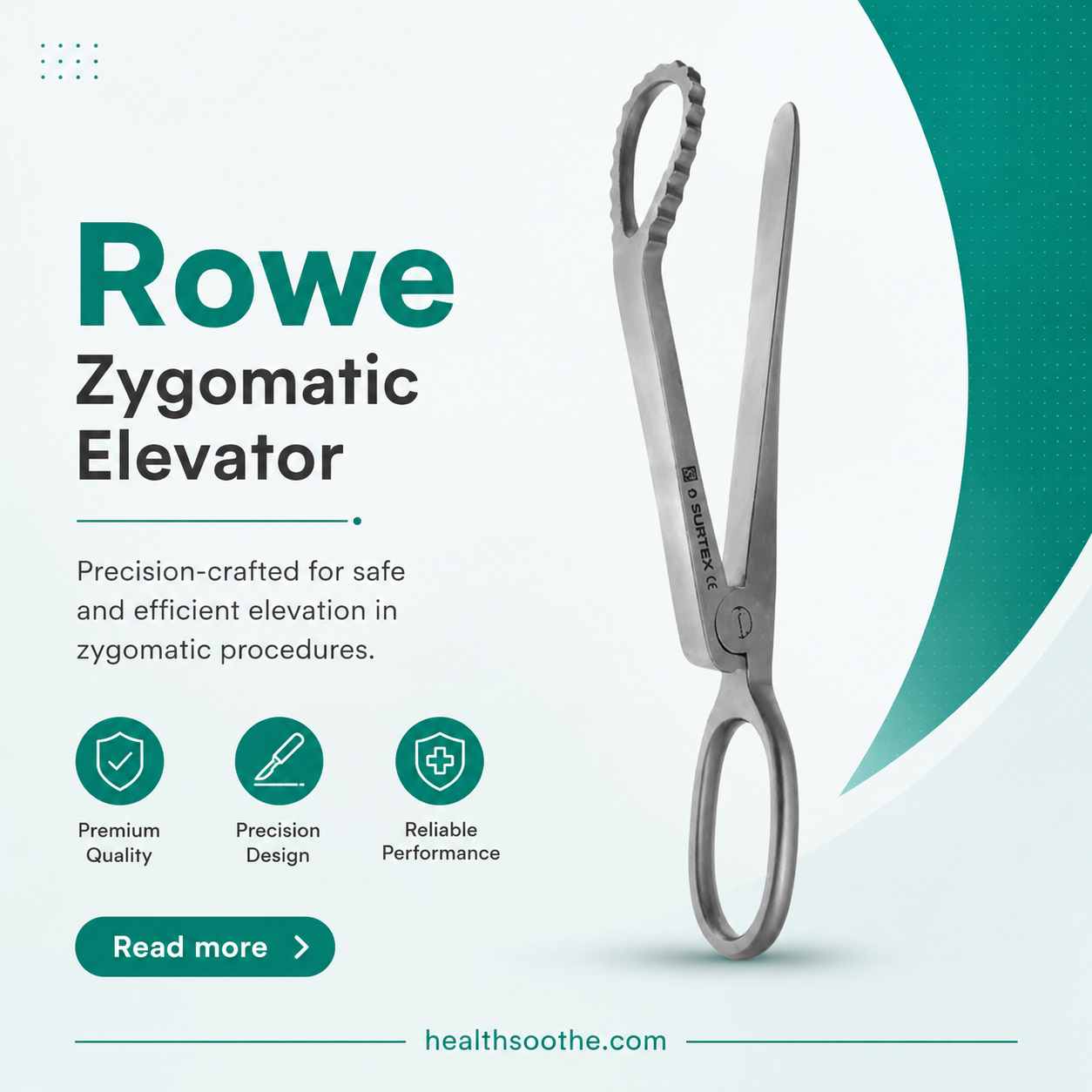
A broken cheekbone changes the shape of a person’s face almost immediately. The zygomatic bone sits right under the eye and gives the cheek its contour, so when it fractures, the face can look sunken, flattened, or uneven on one side. Putting that bone back where it belongs takes a tool built for the job, and that tool is the Rowe Zygomatic Elevator.
This article covers what the Rowe Zygomatic Elevator is, how it’s built, why it’s shaped the way it is, and how oral and maxillofacial surgeons use it to reduce a depressed zygomatic fracture.
What Is a Rowe Zygomatic Elevator?
The Rowe Zygomatic Elevator is a hand instrument used to lift, or “elevate,” a fractured zygomatic bone back into its normal position. It’s made of stainless steel and built with two different working ends, one on each side of a solid, fenestrated handle.
One end has a smooth, spatula-shaped jaw that slides under the depressed bone and applies upward pressure to push it back into place. The other end has a fenestrated, or window-cut, jaw that helps the surgeon mark and locate the exact fracture site before the bone is moved. The handle itself has an opening cut through it, which gives the surgeon a firmer hold and better feel while applying force, especially important since this instrument has no ratchet or lock. Every bit of pressure is controlled by the surgeon’s hand.
It’s named after Andrew Rowe, the British oral surgeon credited with developing the technique most commonly paired with this instrument.
Understanding Zygomatic Arch Fractures
The zygomatic bone, commonly called the cheekbone, connects to the skull at four points: the frontal bone near the eyebrow, the maxilla near the upper jaw, the temporal bone at the side of the skull, and the sphenoid bone behind the eye. A direct hit to the cheek, from a car accident, a fall, a sports injury, or an assault, can break one or more of these connections. When all four break at once, it’s often called a tripod fracture or a zygomaticomaxillary complex (ZMC) fracture.
A depressed zygomatic arch fracture, where the broken bone caves inward, is one of the more common patterns seen in emergency rooms and trauma centers across the United States. Beyond the visible flattening of the cheek, patients can also experience jaw stiffness, numbness around the cheek and upper lip, double vision, or trouble opening their mouth fully if the arch presses against the muscle that controls the jaw.
Surgeons typically wait for facial swelling to go down before operating, unless the injury is blocking the jaw from moving or there’s pressure on the eye. Once the swelling clears, the bone is usually still movable enough to be repositioned without needing plates and screws, which is where the Rowe elevator comes in.
How the Rowe Elevator Is Used in Surgery
The Rowe Zygomatic Elevator is most often used through the Gillies temporal approach, a technique that lets the surgeon fix the fracture without opening up the face. The general steps look like this:
- A small incision, roughly two centimeters long, is made in the hairline above and slightly behind the ear, in the temporal region.
- The surgeon dissects down through the temporal fascia to reach a plane just beneath the temporalis muscle, which sits under the depressed bone.
- The spatula-shaped end of the elevator is guided through this opening and positioned underneath the fractured zygomatic arch.
- The surgeon applies steady upward and outward pressure, lifting the bone back to its original position. A distinct shift, sometimes felt or even heard as a soft pop, usually signals the fracture has been reduced.
- The surgeon checks facial symmetry and jaw movement before closing the small incision, often with just one or two sutures.
Because the spatula end is smooth and rounded rather than sharp, it’s built to lift bone without tearing through soft tissue or nicking the temporal blood vessels nearby. That detail is exactly why a purpose-built instrument like this works better than reaching for a generic elevator or periosteal tool not shaped for the job.
Design and Specifications
Here is a quick look at how the instrument is typically built and classified.
| Specification | Detail |
|---|---|
| Instrument type | Elevator |
| Material | Surgical-grade stainless steel |
| Finish | Satin |
| Handle | Solid, fenestrated for grip and control |
| Working ends | One spatula-shaped jaw, one fenestrated jaw |
| Ratchet lock | None |
| Sterilization | Autoclavable, reusable |
| Typical category | Oral and maxillofacial / general surgery instruments |
Who Uses This Instrument
Oral and maxillofacial surgeons (OMFS) use the Rowe Zygomatic Elevator most often, since facial trauma and reconstructive jaw surgery fall directly under their training. Plastic and reconstructive surgeons reach for it during facial trauma repair, and some ENT surgeons use it when a zygomatic fracture overlaps with sinus or orbital floor injuries. It’s a standard piece of equipment in any trauma center or hospital that treats facial fractures on a regular basis.
Care, Cleaning, and Sterilization
Like most stainless steel surgical instruments, the Rowe Zygomatic Elevator is reusable and autoclavable. Because it has no hinge or ratchet, it’s actually one of the simpler instruments to clean. The fenestration in the handle is the one spot that needs a closer look during decontamination, since debris can settle in the cutout if it isn’t brushed and rinsed properly. After cleaning, it gets inspected for bends, dull edges, or pitting on the spatula tip before going back into a sterile tray. A bent or worn tip can make it harder to get a smooth, controlled lift, which matters when the surgeon is working through a small incision with limited visibility.
Final Thoughts
The Rowe Zygomatic Elevator is a simple-looking instrument that solves a specific, common problem: getting a fractured cheekbone back into place without opening up the face. Its spatula tip, fenestrated jaw, and grip-friendly handle were all shaped around one technique, the Gillies temporal approach, and decades of use in trauma surgery have kept that design largely unchanged. For any facility that treats facial trauma, it remains a standard tool in the tray, built for one job and built to do it well.