
The ‘CVA’…Maybe once or twice, in your life, you might have a kidney or urinary problem or any other problem affecting the bottom bones of your ribs, and during the hospital diagnosis, you must have heard words like CVA, the costovertebral angle, or CVA tenderness.
You must have definitely wondered what does this CVA mean? What is the costovertebral angle all about? What about CVA tenderness?
Today’s article will explain all there is to know about your costovertebral angle; what causes pain at the costovertebral angle, how comes about CVA tenderness, and how do you prevent costovertebral tenderness or costovertebral pain? And much more.
Read on to know all these.
About the Costovertebral Angle – What is the CVA?
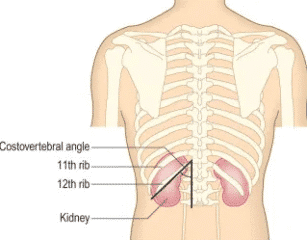
The costovertebral angle (CVA) is placed underneath the ribcage at the 12th rib on your back.[mfn]https://en.wikipedia.org/wiki/Costovertebral_angle[/mfn] It’s the 90-degree angle generated between the rib’s curvature and your spine.
“Costo” is derived from the Latin term for rib, whereas “vertebra” is derived from the Latin phrase for joint.
On either side, your kidneys are positioned behind the CVA. Pain in this location might be caused by a kidney infection, a back condition, or another type of internal disease. You should consult a doctor when you feel soreness or discomfort in this region.
Diagrams of the Costovertebral Angle
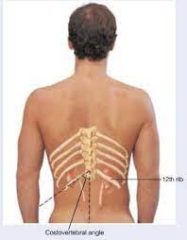
Costovertebral Angle Tenderness – What Causes Costovertebral Angle Pain?
Many causes might cause CVA pain or tenderness in this region. The kind of CVA pain (symptoms) you are experiencing may reveal the source of the problem. Here are some probable explanations:
- Infection of the kidneys
Because of their position, the kidneys are quite a potential source of CVA discomfort. Kidney discomfort may occur on either one or even both sides. You could have an infection if your CVA discomfort is followed by fever or chills, as well as pus and blood in your urine.
Pyelonephritis, often known as kidney infection, is rather frequent. It affects 15 out of every 10,000 females as well as 3 out of every 10,000 men. Every year, over 250,000 cases are identified. The illness is mainly caused by germs that enter the lower urinary system. E. coli bacteria are found in 70 – 95 percent of patients.
Another of the most prevalent severe illnesses in young women is pyelonephritis. Kidney infections may be fatal if they are not treated properly. Pyelonephritis is another frequent significant pregnancy complication, affecting 1 to 2% of pregnant women.
If you have pyelonephritis symptoms, you should consult your doctor once in a while.
- Kidney stones
Stones may develop when minerals or salt cluster together in your kidneys. If the stones are little, they may not be painful. Larger kidney stones, on the other hand, maybe excruciatingly painful when they pass through your urinary system. Diabetes and obesity are major risk factors for the production of kidney stones.
Kidney stones are still a frequent thing. According to a 2012 nationwide survey, kidney stones harm roughly 1 in every 11 individuals living in the USA. Men are more impacted than women.
You could have a huge kidney stone if you feel an acute ache in the CVA area. Other signs of kidney stones include:
- discomfort in the lower abdomen
- urination discomfort
- blood in your pee
- vomiting and nausea
- fever or chills
- Polycystic kidney disease (PKD)
Polycystic kidney disease is hereditary; however, symptoms generally appear between the ages of 30 and 50. This condition makes fluid-filled cysts harm and enlarge your kidneys. This may eventually result in kidney failure and end-stage renal disease.
Pain in the Costovertebral angle area might be a warning sign. Other signs and symptoms include:
- stomach discomfort or soreness
- blood in your pee
- a lot of urinating
- skin prone to bruises
- fatigue
- Infection of the urinary tract
Urinary tract infections (UTIs) are a very prevalent bacterial illness. Based on a 2015 study, UTI symptoms accounted for an estimated total of 10.5 million medical office visits in the United States in 2007, incurring the economy of $3.5 billion in healthcare expenditures and lost work time.
The location of the infection determines the severity of the UTI symptoms. One sign of a higher tract UTI is CVA tenderness and discomfort. This may have an impact on your kidneys. Other signs and symptoms include:
- fever and chills
- vomiting and nausea
- Lower-tract UTIs cause problems with the bladder and urethra. Among the symptoms are:
- increased urination frequency and urgency
- pee that is bloody or hazy
- burning urination
- pelvic or rectal discomfort
- Obstruction of the urinary tract
A urinary tract blockage is a partial or complete blockage of urine flow via the bladder, kidneys, or urethra. It’s quite common, with estimates ranging from five in 10,000 to 5 in 1,000 persons, depending on the reason.
In youngsters, the blockage might be structural, caused by a congenital defect. It is frequently caused by stones in the kidney and urinary systems in young people. Causes in the elderly include:
- tumors
- enlarged prostate
- cancer of the prostate
- stones
Symptoms differ according to the kind of blockage. One sign is pain and soreness in the CVA region. Others are as follows:
vomiting and nausea
alterations in urination
- Costochondritis
Costochondritis is an infection of the cartilage that connects the ribs to the breastbone. The discomfort might be minimal to severe. The discomfort might sometimes be mistaken for that of a cardiac problem. It may also produce discomfort in the CVA region.
Costochondritis’s actual etiology is not always known. It may be caused by a virus, trauma, or strain. This discomfort fades with time.
Other Causes of Costovertebral Tenderness or Costovertebral Pain
Other potential sources of CVA pain or CVA tenderness include:
- a chest or spine injury
- dislocation of a joint
- fractured ribs
- appendicitis
- shingles
- abscess in the abdomen
- Inflammation of the pelvis
The Diagnosis of Costovertebral Tenderness or CVA pain
Talk to your doctor if you are experiencing CVA discomfort or soreness.[mfn]https://www.healthline.com/health/costovertebral-angle[/mfn] It is critical to identify and address the source of the discomfort.
A typical evaluation for CVA soreness is for your doctor to place one hand flat on the CVA region and pound the flat palm with the other fist. This enables the kidneys to vibrate.
When your doctor conducts this, you might be sitting, standing, or laying down. If you do not experience any discomfort while your doctor performs this procedure, kidney involvement may be ruled out.
Watch the video below to check out the assessment:
In addition to the CVA evaluation, your doctor will examine your medical records and question you about any symptoms. Questions might include:
- When did they start?
- How long does each bout last?
- Is there anything that you feel or know that helps make you feel better?
They will evaluate you physically and will most likely prescribe many tests to determine what is causing your discomfort. The following tests may be performed:
- Urinalysis to detect bacteria
- Urine culture for bacterial identification
- Blood examinations
- Radiographs of the abdomen
- Renal ultrasound
- CT scan or MRI to detect cysts
Other tests may be ordered based on your complaints (symptoms) and what your doctor feels is the reason.
Risk Factors Associated with Costovertebral Tenderness or Pain
Risk factors associated with CVA tenderness or pain differ according to the source of the discomfort.[mfn]https://epomedicine.com/clinical-medicine/costovertebral-or-renal-angle-tenderness/[/mfn] The starting condition is connected to your risk. For instance, if you have recurrent UTIs, particularly ones affecting the top urinary tract, you are more likely to have CVA discomfort and soreness.
Other variables that may raise your risk include:
- Stones in the kidneys
- Previous family or genetic history of UTIs or kidney stones
- Diabetes
- Family history of renal illness, a heart attack, or a stroke
- Pregnancy
- 3 or more times each week of sexual intercourse
- Incontinence due to stress
- Recent usage of spermicide
- Trauma
Treatment of Costovertebral Pain or CVA tenderness
Your therapy will be determined by the source of your CVA discomfort. If the problem persists, you may be sent to a specialist.
- Infection of the kidneys: Antibiotics will be administered if you develop a kidney infection. Your infection should be gone within 48 to 72 hours. If your infection is serious or you are pregnant, you may need to be hospitalized.
- Stones in the kidney: The severity of kidney stones determines the treatment. For tiny stones, your doctor might prescribe pain relievers and advise you to drink plenty of fluids to wash away the stones. The doctor may employ lithotripsy for bigger stones. Shock waves are used to break down the stones into tiny bits that can flow through your urine. Ureteroscopy is another therapy option. The doctor uses an instrument to locate the stones and split them up into tiny pieces during this therapy. If it’s little, the doctor may be able to remove it. The ureteroscopy or lithotripsy operation will be performed under general anesthesia.
- UTIs: Antibiotics tailored to the microorganisms implicated are administered for UTIs. Antibiotic resistance might be an issue. To address this issue, new medicines are being developed.
In Conclusion
If you experience CVA pain or CVA tenderness, you should consult your doctor. It is critical to determine the source of the discomfort and address it. CVA pain is often a symptom of kidney diseases, like kidney stones or infections. A UTI is another possibility. Early therapy may help avert problems in any of these circumstances.
[bwla_faq faq_topics=”frequently-asked-questions-concerning-the-costovertebral-angle” sbox=”1″ paginate=”1″ pag_limit=”5″ list=”1″ /]