
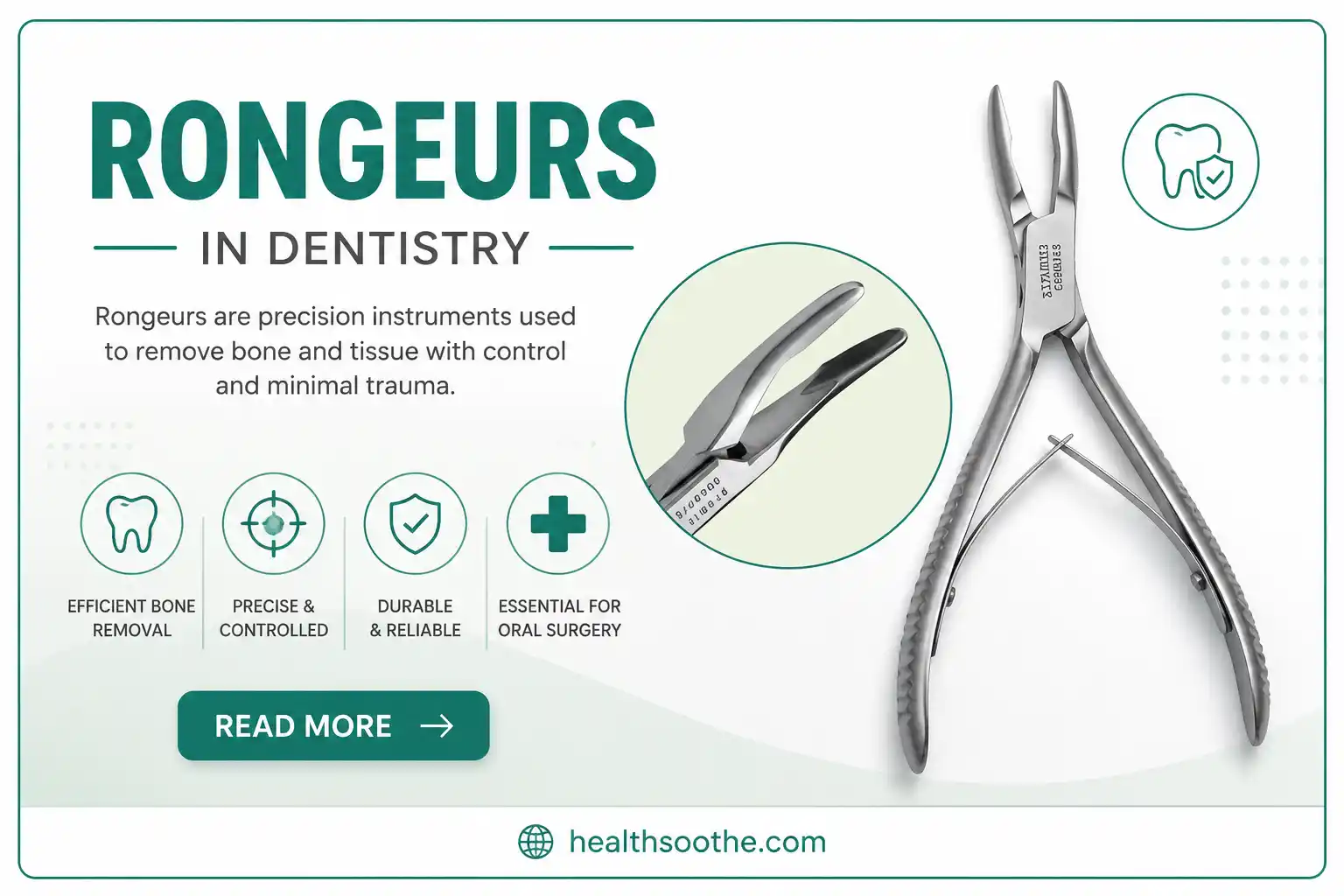
Walk into any oral surgery suite and you will find a tray of instruments that most patients never quite recognise. Among forceps, elevators, and retractors sits one piece of equipment that plays a specific and important role in bone management: the rongeur. It does not look like much at first glance, a hinged instrument that resembles a pair of pliers with a small, sharp, scooped jaw at the working end. But in skilled hands, it is the instrument that allows a clinician to trim irregular bone, smooth a ridge after extraction, and prepare tissue for healing or prosthetic placement.
This article explains what rongeurs are, the types used in dentistry, how dentists use them clinically, and the detailed role that dental nurses carry out before, during, and after a rongeur procedure. Because oral surgery depends on teamwork, understanding both sides of that team is essential for anyone working in a dental clinical environment.
What Is a Rongeur?
The word rongeur comes from the French verb ronger, meaning to gnaw. That is a reasonable description of what the instrument does: it bites away at bone in small, controlled increments, removing material piece by piece rather than cutting in a single pass. Surgitronix describes surgical rongeurs as essential instruments used for the precise cutting, shaping, or removal of delicate tissues and bone fragments to facilitate various procedures. They feature long, scoop-shaped jaws, sharp edges, and a ratchet or spring mechanism to cut through dense or thick tissue with controlled force.
In the dental context, rongeurs are used primarily during oral surgical procedures where bone management is required. That includes post-extraction ridge smoothing, alveoloplasty, implant site preparation, and certain periodontal surgical cases. GerDentUSA describes the dental bone rongeur as an instrument used in oral surgeries to remove bone particles and fragments and to eliminate the sharp edges of the alveolar crest that can remain after tooth extraction.
The NIH’s StatPearls resource on oral surgery instruments confirms that bone rongeurs aid in bone removal and can address bony prominences or irregular ridges, which can then be smoothed with a bone file to improve healing. This tells you something important about how rongeurs fit into a procedure: they are rarely the only instrument used. They work alongside bone files, surgical burs, periosteal elevators, and suction to achieve the clinical result.
How a Rongeur Is Built
Understanding the anatomy of a rongeur helps explain both how it works and why the dental nurse’s handling and decontamination responsibilities matter so much.
All rongeurs share the same fundamental structure. There are two handle arms, typically spring-loaded, that drive a joint mechanism connecting to a working tip. The tip contains two cup-shaped or scooped jaw surfaces, one fixed and one that closes against it when the handles are squeezed. The jaw edges are ground to a sharp bevel so they cut through bone cleanly when compressed. MEDESY’s bone rongeur range notes that their instruments use concave curette-shaped tips with special extremely sharp serrations to maximise cutting efficiency, and grooved handles with spring-action systems for controlled use.
The joint that drives the jaw can be either single action or double action. In a single-action design, the joint has one pivot point. In a double-action design, a compound hinge amplifies the force the clinician applies, as Surgitronix explains, providing enhanced cutting power with less effort from the operator. This matters clinically: double-action designs are chosen for denser or thicker bone, while single-action designs are better suited to fine, delicate work where excess force would be a risk.
All dental rongeurs intended for clinical use are constructed from surgical-grade stainless steel. This material withstands the high temperatures and pressures of autoclave sterilisation, resists corrosion from blood and saline, and maintains the sharpness of the jaw edges through repeated use and reprocessing cycles.
Types of Rongeurs Used in Dentistry
Several distinct rongeur designs exist, and the right choice depends on the clinical situation, the anatomy of the area, the density of the bone involved, and the specific procedure being performed. The following are the types most commonly found in dental and oral surgical settings.
Blumenthal Rongeur
The Blumenthal rongeur is one of the most widely used designs in general dental oral surgery. GerDentUSA describes the Blumenthal as having an end-cutting design and notes that it is suitable for most dentoalveolar procedures. It can remove large amounts of bone effectively and efficiently, making it the default choice for post-extraction ridge work and alveoloplasty. The instrument typically features a jaw at 45 to 90 degrees to the handle shaft, and the MEDESY product range and GerDentUSA both offer it in 3mm, 4mm, and larger tip dimensions to accommodate different bone volumes.
One clinical caution noted by GerDentUSA is that it is not advisable to remove large chunks of bone in one bite. Small amounts of bone should be removed with many incremental bites to maintain control and avoid unnecessary trauma to surrounding tissue.
Friedman Rongeur
The Friedman rongeur is a slightly curved, single-action instrument typically available in a 5.5 inch length with a 45-degree angled tip. Dental Implant Technologies notes that Friedman rongeurs are used in reconstructive and restorative dental surgeries and are available in both standard and mini sizes to suit narrow spaces where access is limited. The 45-degree angled jaw allows the clinician to approach bone from a different axis than the Blumenthal, which is useful in tighter surgical fields.
Beyer Rongeur
The Beyer rongeur is designed specifically for bone modification and handling. GerMedUSA notes that its jaws are cup-shaped, which makes it easy to scoop up bone fragments, and that it is particularly used for removing the sharp edges of bone after extraction. The palm grasp technique is used with Beyer rongeurs, meaning the instrument is held like a plier and operated with the whole hand rather than the fingertips alone.
Kerrison Rongeur
The Kerrison rongeur is a specialised design most familiar in neurosurgery and spinal procedures, but it has found a specific role in dental implantology as a sinus rongeur. Dental Implant Technologies describes the Kerrison as the most commonly used sinus rongeur, prized for its 45-degree angle design that allows ergonomic use and easy access to the sinus. Surgitronix notes that Kerrison rongeurs feature up-biting or down-biting curved jaws, a slender shaft, and a plier-grip style handle, and are available in jaw sizes from 2 to 6 mm to suit all applications. In dental implant cases involving lateral window sinus lifts, a Kerrison allows controlled removal of the bony window without excessive force near the sinus membrane.
Luer and Ruskin Rongeurs
Luer rongeurs and Ruskin rongeurs are heavier-duty instruments more commonly encountered in orthopedic and general surgical settings, though some oral and maxillofacial surgery practices include them for cases requiring higher cutting force. Surgitronix categorises Ruskin and Luer instruments in the double-action rongeur group and describes their scoop-type jaws as allowing the clinician to clear space or scoop out bone to increase access to the surgical area. Their primary applications are larger-scale bone recontouring and reconstruction procedures, as noted by Surgitronix.
Cleveland Rongeur
The Cleveland rongeur is identified by MEDESY and GerMedUSA as a specifically dental instrument, typically available in lengths of 5.5 inches and 6.75 inches with a curved 4mm jaw. GerMedUSA notes that Cleveland rongeurs maximise the force at the cutting surface when cutting bone through increased leverage, and that their double-action joint allows easy manipulation and holding. They are well-suited to dental procedures where additional cutting power is needed without switching to a heavy orthopedic instrument.
Key Features Across Rongeur Types
| Feature | Clinical Significance |
| Sharp, scoop-shaped jaws | Precisely remove tough or dense bone fragments in small increments |
| Angled jaw (30, 45, or 90 degrees) | Access confined surgical spaces, sinus, and posterior alveolar ridge |
| Single-action joint | Controlled force for delicate bone work; suitable for thin or fragile bone |
| Double-action joint | Increased mechanical advantage for dense or thick bone sections |
| Spring-loaded handles | Reduces hand fatigue during prolonged procedures; improves control |
| Ergonomic grip surface | Prevents slippage when handles are wet with blood or saline |
| Surgical stainless steel | Withstands repeated autoclaving; resists corrosion; maintains edge sharpness |
| Variety of tip sizes (2 to 6 mm) | Accommodates different anatomical locations and bone volumes |
What the Dentist Does with a Rongeur
Rongeurs are instruments reserved for use by the dentist or oral and maxillofacial surgeon. Their application falls within the direct clinical scope of the registered clinician, not the dental nurse, as confirmed by GDC scope of practice boundaries for the dental team. Understanding what the clinician does with this instrument gives the dental nurse the context needed to prepare appropriately and support the procedure effectively.
Post-extraction bone smoothing
After a tooth is extracted, the bony socket walls sometimes leave sharp projections, rough ridges, or irregular margins along the alveolar crest. These irregularities cause discomfort for the patient, interfere with soft tissue closure, and can complicate denture fitting or implant placement if not addressed. GerDentUSA confirms that the bone rongeur is used to remove the sharp edges of the alveolar bone ridge after tooth extraction. The clinician elevates the soft tissue flap to expose the bone, works around the socket margin with the rongeur in small biting increments, and checks the surface by palpation between passes before closing with sutures.
Alveoloplasty
Alveoloplasty is the surgical reshaping of the alveolar ridge to create a foundation suitable for a removable prosthesis, implants, or other treatment. Delta Dental’s clinical criteria document confirms that alveoloplasty may be accomplished by the use of rongeur forceps, bone files, and bone burs in a handpiece once the bone is visualised and accessible. The degree of bony irregularity determines the instrument sequence: coarser work is done with the rongeur first, then refined with bone files or burs, and the site is then irrigated with saline before closure.
ScienceDirect’s review of alveoloplasty techniques highlights that a rongeur, bone file, handpiece with bur, or a mallet and osteotome are all viable options for bony recontouring, and that irrigation with normal saline during the procedure is critical to maintain bony temperature below 47 degrees Celsius to prevent thermal damage to bone cells. The dental nurse plays a direct role in maintaining this irrigation flow, which is covered in the nursing section below.
Implant site preparation and sinus procedures
When preparing a site for dental implant placement, particularly in areas with uneven bone topography or bony undercuts, a rongeur allows the surgeon to trim the ridge to create a flat, stable platform for the implant. In sinus lift procedures, a Kerrison rongeur is used to remove the lateral bone window carefully so the sinus membrane can be elevated without perforation. Dental Implant Technologies explains that Kerrison rongeurs ensure accuracy and safety in sinus procedures and allow for safer and more accurate surgeries through their ergonomic, angled design.
Pre-prosthetic surgery
Before full or partial dentures are fitted, some patients require surgical preparation of the alveolar ridge to remove bony prominences, tori, or undercuts that would prevent the prosthesis from seating correctly. iCliniq’s summary of alveoloplasty procedures notes that the irregular bone formation is removed with a bur, rongeur, or bone file under profuse saline irrigation, and the ridge is then palpated to ensure all irregularities are removed before the flap is replaced. Wikipedia’s article on alveoloplasty confirms that the degree of bony abnormality dictates the most effective method, and that a bone rongeur is one of the primary instruments for this work.
How the rongeur is held and operated
A palm grasp is the standard technique, as GerDentUSA explains. The instrument is held like a plier, with the handles resting in the palm and the fingers providing grip and control. The clinician positions the jaw tips against the bone margin, compresses the handles to close the jaws and remove a small bite of bone, releases the handles to allow the spring mechanism to open the jaws again, and repositions for the next bite. This process is repeated methodically until the desired bone contour is achieved. Working in small increments, rather than attempting to remove large volumes in one bite, is essential for safety and precision.
The Dental Nurse’s Role
Although the dental nurse does not handle the rongeur during the clinical procedure, their contribution to every rongeur-assisted case spans preparation, active chairside support, and post-procedure decontamination. Each of these phases carries clinical and regulatory weight.
Pre-procedure preparation
Before the patient is seated for any oral surgical procedure involving rongeurs, the dental nurse is responsible for setting up the clinical environment to a standard that supports safe and efficient surgery. This includes selecting the correct rongeur type and size for the planned procedure based on discussion with the clinician, placing it on the instrument tray in the sequence in which instruments will be used, confirming that all instruments have been through a complete and documented sterilisation cycle, and preparing irrigation solutions, suction equipment, surgical lighting, and any materials needed for flap closure such as sutures.
StatPearls on oral surgery instruments confirms that four-handed dentistry can be utilised to maximise efficiency during oral surgical procedures, and that the dental nurse is central to this model. The nurse laying instruments out in order of use, having materials available without the clinician needing to ask, and anticipating the next step in the sequence all reduce procedure time and patient chair time.
Personal protective equipment is also a nursing preparation responsibility. For oral surgical procedures involving bone removal, the risk of blood, bone fragment, and saline splatter is significant. The dental nurse must ensure that both they and the clinician are wearing appropriate PPE including gloves, masks, protective eyewear, and either a visor or surgical face shield where splash risk is high. The CDC’s infection control guidelines for dental settings require that PPE appropriate to the level of exposure risk be selected and worn correctly before the procedure begins.
Patient preparation and reassurance
Dental nurses are often the team member who has the most contact with the patient before the clinician enters the room. For patients attending for oral surgery, anxiety is common. The dental nurse can explain in plain language what the procedure involves, what sensations the patient might expect, and what signals the patient can use if they need the clinician to pause. This kind of informed, calm communication is documented in the GDC Skills England occupational standard for dental nurses (2023), which includes specific standards around managing patient anxiety and monitoring, supporting, and reassuring patients through effective communication.
Chairside assistance during the procedure
During the procedure itself, the dental nurse carries out several simultaneous tasks that are critical to the clinician’s ability to work safely and precisely.
Suction management is the most continuous of these. Bone removal with a rongeur releases bone fragments, blood, and pooled saline into the surgical site. The dental nurse uses a surgical suction tip, with Frazier-style tips being commonly used in oral surgery as noted by StatPearls, to keep the site clear so the clinician can see what they are doing. Inadequate suction forces the clinician to work in a flooded field, increasing the risk of error and extending procedure time.
Retraction is a second key task. The dental nurse uses a retractor or mirror to hold back the cheek, lip, or tongue to give the clinician unobstructed access to the surgical site. This is particularly important during rongeur use because the instrument has a sharp working end and any movement of soft tissue toward the jaw tips during bone biting creates a risk of soft tissue laceration. GerDentUSA specifically notes that cheeks and lips should be carefully retracted to ensure no damage occurs while the instrument is activated.
Irrigation support is the third concurrent task. ScienceDirect confirms that saline irrigation during alveoloplasty must be maintained to prevent bone temperature exceeding 47 degrees Celsius. The dental nurse manages the flow of sterile saline over the surgical site during periods when the clinician is using a surgical handpiece, and keeps the syringe ready for irrigation between rongeur passes. When the clinician is ready to irrigate the socket before closure, the nurse delivers the saline in a controlled stream.
Instrument passing rounds out the chairside role. As the procedure progresses from rongeur work to bone file smoothing to socket irrigation to suturing, the dental nurse passes instruments in the correct sequence using safe transfer technique. Sharp instruments including the rongeur are passed and received in a way that minimises the risk of needlestick injury or accidental sharps contact. Safe instrument passing is a core competency listed in the GDC Skills England standard and is reinforced by CDC guidance on sharps management in dental settings.
Post-procedure decontamination and rongeur care
After the procedure is complete and the patient has left the clinical area, the dental nurse is responsible for the decontamination of all instruments used, including the rongeur. This is not a minor task. Dental Nursing’s article on preparing instruments for decontamination explains that initial cleaning must take place chairside, where visible soiling from blood and dental materials is removed from instruments before they dry or set. Dried blood in the spring mechanism or hinge of a rongeur is significantly harder to remove and can compromise the effectiveness of subsequent sterilisation.
StatPearls confirms that dental nurses often undertake decontamination tasks when there is no dedicated staff member for cleaning and sterilising instruments, and notes that all dental care professionals must understand and be trained in cross-infection control, which is essential given the exposure-prone nature of many dental procedures.
The decontamination sequence for a rongeur typically follows these steps in compliance with HTM 01-05 guidance in England, with equivalent standards applying across Wales, Scotland, and Northern Ireland through WHTM 01-05 and SDCEP respectively.
- Chairside pre-cleaning: remove gross soiling, including bone fragments and blood, from the rongeur using a damp cloth or gauze before transferring the instrument to the decontamination area.
- Transport: place the rongeur in a rigid, sealed, leak-proof container labelled as contaminated, separate from clean items, and transport it to the decontamination area as described in Dental-Nursing.co.uk guidance.
- Cleaning: process the rongeur through a washer-disinfector where available, as this is the preferred method over manual cleaning. The hinge mechanism and spring of a rongeur require particular attention to ensure the cleaning cycle reaches internal surfaces. Where manual cleaning is necessary, appropriate PPE must be worn and an approved cleaning agent used.
- Inspection: after cleaning and before packaging, inspect the rongeur jaws for retained debris, check the spring mechanism functions correctly, and confirm the cutting edges are intact and not damaged.
- Packaging: package the rongeur in an appropriate pouch with a Class 1 chemical indicator to show it has been through the sterilisation cycle.
- Sterilisation: autoclave the packaged rongeur according to manufacturer guidance and practice protocols, maintaining a sterilisation log as required by HTM 01-05.
- Storage: store the sterilised, packaged rongeur in a clean, dry area away from potential contamination until it is required for the next procedure.
Dental-Nursing.co.uk makes an important observation worth repeating: without appropriate and effective instrument reprocessing, a practice either cannot operate or operates less efficiently. The rongeur is a reusable stainless steel instrument with a mechanical hinge, and its safe reuse depends entirely on correct decontamination.
Record keeping
The GDC Skills England occupational standard for dental nurses includes accurate documentation as a core skill. For oral surgical procedures involving rongeurs, the dental nurse may be asked to assist with contemporaneous recording of the instruments used, the lot numbers of any materials, the sterilisation cycle reference for instruments used, and the patient’s post-operative instructions. In practices using digital records, the nurse may input this data directly during or after the procedure.
Patient aftercare instructions
Following bone surgery with rongeur use, patients typically receive post-operative instructions covering expected symptoms such as swelling, bruising, and mild bleeding, along with guidance on diet, oral hygiene around the surgical site, and when to seek advice if healing appears unusual. The dental nurse often delivers or reinforces these instructions at the end of the appointment. Clear, accurate aftercare communication supports healing and reduces the number of avoidable post-operative phone calls or emergency appointments.
Instrument Maintenance and Longevity
A rongeur is a precision instrument, and its cutting performance depends directly on how well it is maintained. The spring mechanism must function smoothly so that the jaws open fully between bites. The jaw edges must remain sharp enough to cut bone cleanly rather than crush or splinter it. Regular inspection during the decontamination sequence allows the dental nurse or decontamination lead to identify instruments that require servicing or replacement before they fail during a procedure.
Surgitronix notes that rongeurs are durable and designed for smooth operation. That durability depends on correct decontamination chemistry, avoiding ultrasonic cleaning cycles that are too aggressive for delicate hinge mechanisms, and ensuring instruments are fully dry before packaging to prevent internal rusting at the spring or joint.
Manufacturers including Hu-Friedy, MEDESY, and Premier Dental supply dental rongeurs for oral surgical use. The Hu-Friedy range is listed in the rongeurs category on their website as part of their periodontal and oral surgery instrument line. Premier Dental similarly categorises rongeurs within their periodontal and oral surgery product area. These manufacturers supply instruments to practices that expect consistent quality and documented compliance with surgical instrument standards.
Summary
Rongeurs are a specific class of surgical instrument designed for the controlled removal and shaping of bone. In dentistry, they are used in post-extraction ridge smoothing, alveoloplasty, implant site preparation, sinus access procedures, and pre-prosthetic surgery. The clinician selects the rongeur type based on bone density, access angle, and procedure requirements, working in small incremental bites to achieve the desired bone contour without unnecessary trauma to surrounding tissue.
The dental nurse’s contribution to every rongeur procedure is broad and clinically significant. It covers preparation of the sterile instrument tray, patient communication and anxiety support, chairside suction, retraction, irrigation assistance and instrument passing during the procedure, and the full decontamination and sterilisation cycle afterwards. None of these tasks is optional, and all of them directly affect patient safety and the quality of the surgical outcome.
Understanding rongeurs from both sides of the clinical team, what the dentist does with them and what the dental nurse does around them, reflects the kind of integrated clinical knowledge that raises the standard of oral surgical care in any practice.
Sources and References
- Surgitronix. Types of Rongeurs: Features, Applications and Surgical Benefits. surgitronix.com. Published July 1, 2025. Updated September 22, 2025.
- Premier Dental. Periodontal and Oral Surgery: Rongeurs. premierdentalco.com.
- Hu-Friedy. Rongeurs Product Category. hufriedygroup.com.
- GerDentUSA. Bone Rongeurs: Ideal Instruments for Bone Trimming. gerdentusa.com. Published December 19, 2022.
- GerDentUSA. How Can Dental Rongeurs Help in Precise Teeth Extractions. gerdentusa.com. Published July 30, 2024.
- GerMedUSA. Bone Rongeur: A Fundamental Need in Orthopedic and Neurosurgeries. germedusa.com.
- GerMedUSA. The Amazing Benefits and Uses of Rongeurs. germedusa.com.
- MEDESY. Bone Rongeur Product Range. medesy.it.
- Dental Implant Technologies. Rongeurs: Bone Grafting Instrumentation. dit-usa.com.
- StatPearls / National Institutes of Health. Oral Surgery, Instruments. ncbi.nlm.nih.gov/books/NBK585063/.
- Dental-Nursing.co.uk. Preparing Instruments for Decontamination. dental-nursing.co.uk. Updated August 2025.
- General Dental Council. Guidance on Scope of Practice Effective from 1 November 2025. gdc-uk.org. September 2025.
- Skills England / Institute for Apprenticeships. Dental Nurse Occupational Standard ST1431 v1.0. skillsengland.education.gov.uk. 2023.
- Centers for Disease Control and Prevention. Sterilization and Disinfection in Dental Settings. cdc.gov. Updated March 2026.
- ScienceDirect. Alveoloplasty: Techniques and Clinical Application. sciencedirect.com.
- Wikipedia. Alveoloplasty. en.wikipedia.org. Updated November 2025.
- iCliniq. What Is Alveoloplasty? icliniq.com. Updated August 2023.
- Delta Dental. Clinical Criteria for Alveoloplasty. deltadentalmi.com. Updated 2025.
- Medi Study Go. Alveolar Ridge Correction in Pre-Prosthetic Surgery. medistudygo.com. May 2025.
- Springer Nature Link. Alveoloplasty: Surgical Techniques and Instrument Selection. link.springer.com.
- Health Technical Memorandum 01-05. Decontamination in Primary Care Dental Practices. Department of Health and Social Care, England. 2013.
- GerVetUSA. Dental Bone Rongeur Product Description. gervetusa.com.