
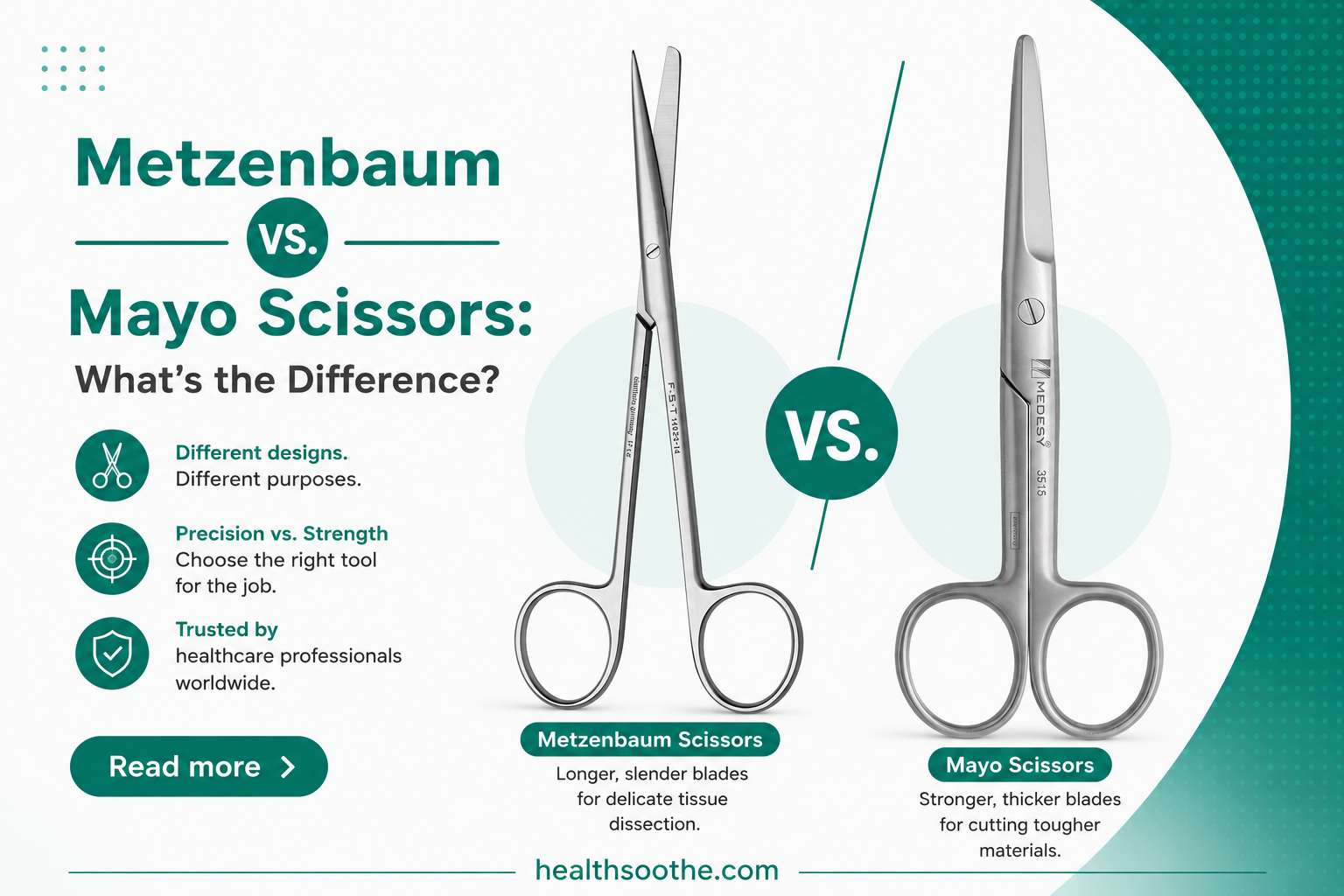
Pick up a pair of Metzenbaum scissors next to a pair of Mayo scissors, and at first glance they look like close cousins. Both have blunt tips and finger-ring handles, and both show up in nearly every surgical tray in the country. But hand the wrong pair to a surgeon mid-procedure, and the difference becomes obvious fast. One is built for soft, fine tissue. The other is built to muscle through tougher material.
Here’s a clear, side-by-side look at what separates Metzenbaum scissors from Mayo scissors, what each one is actually built to cut, and how the curved and straight versions of each get used.
Related Topic:
What Are Metzenbaum Scissors?
Metzenbaum scissors, often just called “Metz” in the OR, have long, thin blades attached to a shorter shank. That long blade-to-shank ratio is what makes them so useful for reaching into deep, narrow spaces in the body without much bulk getting in the way.
They’re built for blunt dissection and cutting fine, soft tissue, not for muscling through anything dense. You’ll find them in:
- Plastic surgery, for precise, low-trauma incisions
- Neurosurgery, for separating blood vessels and removing fine tissue around delicate structures
- Ophthalmic procedures, where a single wrong cut can damage critical structures nearby
- Vascular surgery, for separating vessels and clearing a path for sutures or grafts
Surgeons also reach for Metzenbaum scissors during procedures that call for cutting through the deep rib bed lining without puncturing the lung cavity behind it, a task where the thin blades and careful control really pay off. Common versions include straight delicate, curved, and supercut models with tungsten carbide inserts for a sharper, longer-lasting edge.
What Are Mayo Scissors?
Mayo scissors are heavier and sturdier, with wider blades and a nearly equal blade-to-shank length. That extra bulk gives them the leverage needed to cut through tissue that would dull or bend a thinner blade.
They’re the tool of choice whenever the job calls for cutting through something tough rather than gently separating something fine. That includes:
- Cutting sutures, which is so common that Mayo scissors are sometimes just called “suture scissors”
- Gynecological procedures, for cutting the outer wall of the uterus or dissecting tendons
- Orthopedic surgery, for cutting dense connective tissue
- Urological procedures, including prostatectomies, where tougher tissue needs to be cut cleanly
Mayo scissors also show up regularly in thyroidectomies and laryngectomies for cutting ligaments, and they’re a standard part of the tray in general procedures like hernia repair, appendectomy, mastectomy, and exploratory abdominal surgery.
Metzenbaum vs. Mayo: Side by Side
| Feature | Metzenbaum Scissors | Mayo Scissors |
|---|---|---|
| Blade shape | Thin, narrow blades | Wider, heavier blades |
| Blade-to-shank ratio | Long blades, shorter shank | Blades and shank closer to equal length |
| Built for | Soft, delicate tissue | Tough, dense tissue and sutures |
| Typical length | 5 to 9 inches | 5.5 to 9 inches |
| Common specialties | Plastic surgery, neurosurgery, ophthalmology, vascular surgery | General surgery, orthopedics, OB/GYN, urology |
| Nickname | “Metz” | Sometimes called “suture scissors” |
Straight vs. Curved: Does the Shape Matter?
Both Metzenbaum and Mayo scissors come in straight and curved versions, and the choice between them depends on where in the body the surgeon is working.
Straight blades work best on or near the surface, cutting along a flat plane like skin, sutures, or surface-level tissue. Because the blade lines up directly with the surgeon’s hand and line of sight, straight scissors allow for more direct force and a cleaner, more controlled cut on flat surfaces.
Curved blades are built for going deeper. The curve lets the surgeon work around structures instead of straight through them, which makes a real difference when cutting inside a body cavity or navigating tissue planes that aren’t flat. Curved scissors also tend to give a clearer view of the surgical field, since the surgeon’s hand and the shank sit slightly out of the direct line of sight.
Which One Should You Use?
If the tissue is fine, soft, or sits near something you cannot afford to nick, reach for Metzenbaum scissors. The thin blades and long reach are built for control, not force.
If you’re cutting something with real resistance, like a suture, tendon, or dense connective tissue, Mayo scissors are the better fit. Trying to force tough tissue through a pair of Metzenbaum scissors will only dull the blades and make for a rougher cut. Most operating rooms keep both on the tray, since a single procedure often needs each tool at a different point.
Conclusion
Metzenbaum and Mayo scissors aren’t competing for the same job. One is built for precision on delicate tissue, and the other is built for strength on tougher material. Knowing the difference, and knowing when to use the curved versus straight version of each, is a basic skill that pays off in cleaner cuts, fewer complications, and a smoother procedure from start to finish.