
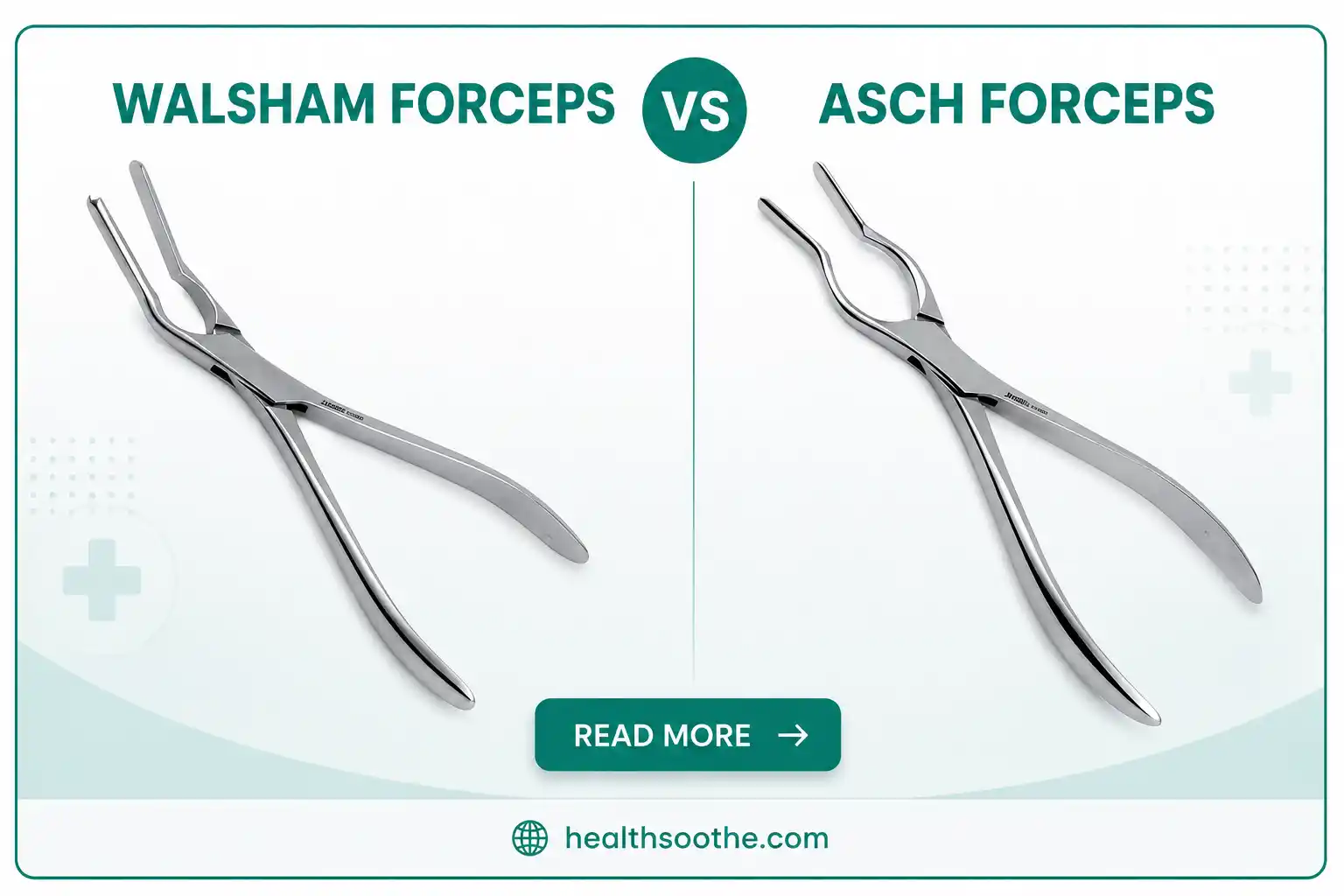
A broken nose and a crooked septum are two different problems, even though people often lump them together. ENT surgeons treat them with two different forceps built for two different jobs: Walsham forceps and Asch forceps. They sit side by side in the same instrument tray, and at a glance they can look like minor variations of the same tool. Pick up either one, though, and the differences in shape, grip, and purpose become clear right away.
Here’s a straightforward look at what each instrument is built for, how they’re shaped, and when a surgeon reaches for one over the other.
Related:
- Metzenbaum vs Mayo Scissors: Key Differences
- 31 Basic Normal Delivery Instrument Sets and their uses
- Gynecology Instruments and Their Uses
What Are Walsham Forceps?
Walsham forceps are built to grip and reposition a fractured nasal bone. The jaws are narrow, slightly serrated, and shaped to hold the bone firmly without crushing the thin mucosa and cartilage lining around it. That concave neck design is what keeps the soft tissue safe while the bone underneath is being moved back into place.
They come in three configurations to match nasal anatomy: universal, left-narrow, and right-narrow, letting the surgeon pick the shape that fits the side of the nose being treated. Walsham forceps are used for:
- Closed reduction of nasal fractures, lifting and realigning displaced bone
- Correcting a deviated septum where bony structure is involved
- Removing tissue or small foreign objects from the nasal passage
The slim, elongated profile is what makes Walsham forceps useful in tight spaces. A surgeon working inside the nasal cavity doesn’t have much room to maneuver, and the narrow jaws let them reach and grip the bone directly without disturbing the surrounding tissue more than necessary. The long handle also gives a steady, controlled grip even during fine, precise movements.
What Are Asch Forceps?
Asch forceps, sometimes called Asch septum straightening forceps, are built for a different problem: a bent or displaced septum, the cartilage and bone wall that divides the two nostrils. A deviated septum can block airflow and lead to chronic sinus issues, and straightening it takes a firmer grip than repositioning a single bone fragment.
The jaws on Asch forceps are wider and blunt, with a double-curved shape that follows the natural contour of the septum. That wider tip spreads out the grip pressure, which gives the surgeon more leverage without tearing through cartilage. Asch forceps are used for:
- Septoplasty, to straighten a deviated nasal septum
- Rhinoplasty, when septal correction is part of the procedure
- Repairing nasal fractures that involve the septal cartilage
Because Asch forceps are built heavier and sturdier than Walsham forceps, they hold up well in procedures involving thicker tissue or polyps, where a lighter instrument might not have enough grip strength to get the job done cleanly.
Walsham vs. Asch: Side by Side
| Feature | Walsham Forceps | Asch Forceps |
|---|---|---|
| Tip design | Narrow, fine, serrated | Wide, blunt, rounded |
| Blade shape | Slim, straight profile | Double-curved to match septal anatomy |
| Grip strength | Lighter, more delicate hold | Firmer, higher-leverage hold |
| Main job | Repositioning fractured nasal bone | Straightening a deviated septum |
| Common procedures | Closed reduction of nasal fractures | Septoplasty, rhinoplasty |
| Available configurations | Universal, left-narrow, right-narrow | Standard angled pattern |
Which One Should You Use?
If the job is repositioning a fractured nasal bone with as little disruption to nearby tissue as possible, Walsham forceps are the right call. Their narrow tips and concave neck are built around that one task.
If the job is straightening a deviated septum or working through thicker cartilage during septoplasty or rhinoplasty, Asch forceps are the better fit. The wider, blunt tips and stronger grip give the surgeon the leverage that delicate, narrow-tipped tools simply don’t have. Many ENT trays carry both, since a single nasal trauma case can involve both bone and cartilage repair in the same sitting.
Common Questions
Can Walsham and Asch forceps be used interchangeably?
No. Walsham forceps are built for fine, narrow work on bone fragments, while Asch forceps are built for a firmer grip on cartilage. Swapping one for the other usually means more force than the tool was designed to handle, which raises the risk of tissue damage.
What’s the main risk with either instrument?
The biggest risk with both is applying too much pressure on delicate mucosal tissue. That’s exactly why both instruments are built with a concave or curved neck, to keep the grip focused on the bone or cartilage and away from the thin tissue surrounding it.
Conclusion
Walsham and Asch forceps treat two different nasal problems, even though they share a tray and a family resemblance. Walsham forceps handle bone with a narrow, careful grip, while Asch forceps handle cartilage with a wider, stronger hold. Knowing which one fits the procedure in front of you isn’t just a technical detail. It’s the difference between a clean repair and unnecessary tissue trauma.