
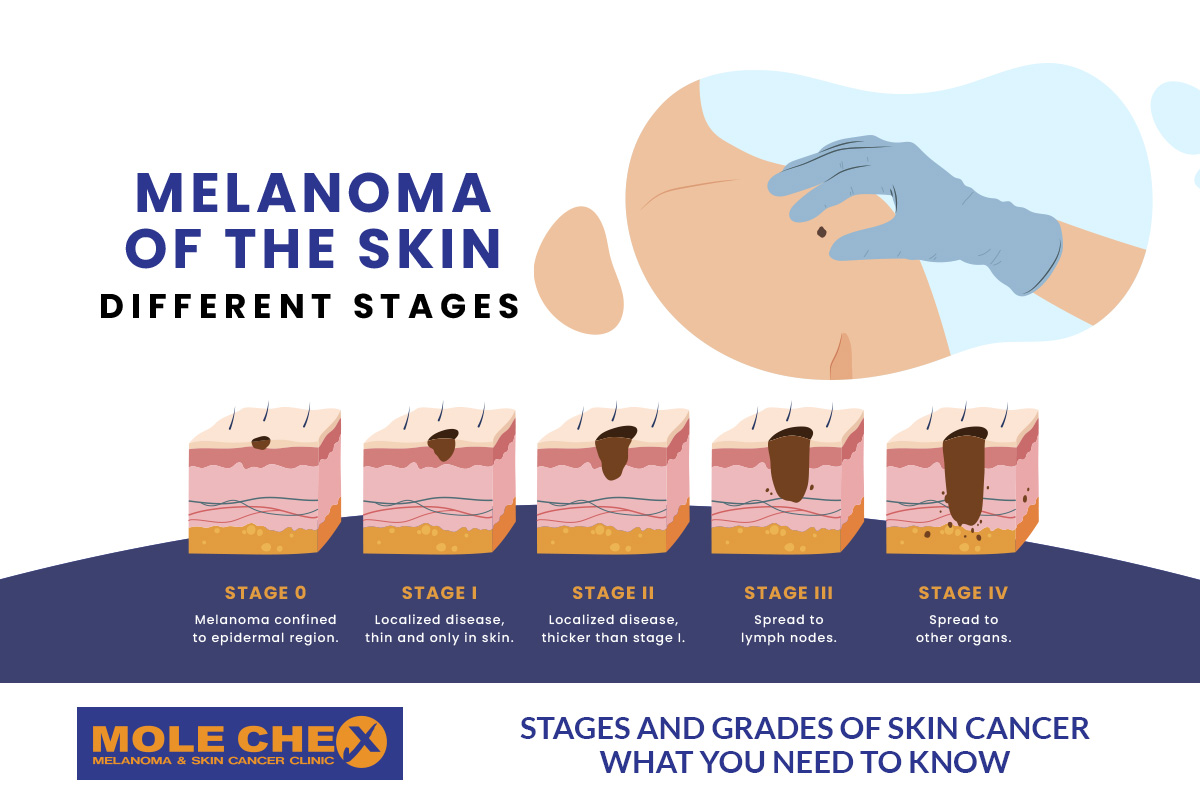
Skin cancer stages are how dermatologists and oncologists translate “we found melanoma” into “here’s exactly how far it’s gone and what we need to do about it.” Two people can both hear that same diagnosis in the same week and walk away with very different outlooks and treatment plans, and the difference almost always comes down to stage. Understanding what each of the skin cancer stages actually means makes a diagnosis feel less like an abstract scare and more like a specific, actionable situation.
This guide focuses on the skin cancer stages used for melanoma specifically, since it’s the form staged this way most often and the one where stage has the biggest impact on outlook. Basal cell and squamous cell carcinoma are staged too, but they’re rarely discussed in these terms since the vast majority are caught and treated well before advanced staging becomes relevant.
How Skin Cancer Stages Are Determined
Melanoma staging uses what’s called the TNM system, developed by the American Joint Committee on Cancer (AJCC):
- T (Tumor): How deep the melanoma has grown into the skin, measured in millimeters. This measurement is called the Breslow depth, and it’s one of the strongest predictors of outcome. Whether the surface of the tumor is ulcerated (broken open) also factors in here.
- N (Nodes): Whether the melanoma has spread to nearby lymph nodes, and if so, how many.
- M (Metastasis): Whether the melanoma has spread to distant organs, like the lungs, liver, or brain.
These three pieces of information combine to assign one of five skin cancer stages, from 0 to 4. In general, the deeper the tumor, the more lymph nodes involved, and the more distant spread present, the higher the stage. For a more detailed technical breakdown of the TNM system, the Melanoma Research Alliance’s staging guide is a solid resource if you want to go deeper than this article does.
Stage 0: Melanoma in Situ
At this stage, abnormal cells are present only in the outermost layer of skin (the epidermis) and haven’t grown any deeper. This is the earliest possible point at which melanoma can be caught, and it’s highly treatable, usually with a simple excision. Five-year survival at this stage is close to 100%.
Stage I: Early Invasive Melanoma
The melanoma has grown into the skin but remains thin (generally under 2mm) and hasn’t reached the lymph nodes or spread anywhere else. It may or may not be ulcerated. Treatment is typically surgical removal with a margin of healthy skin around it, sometimes combined with a sentinel lymph node biopsy to confirm the cancer hasn’t spread. Five-year survival at this stage is around 99%.
Stage II: Higher-Risk Localized Melanoma
The melanoma is thicker, ulcerated, or both, but still hasn’t spread to lymph nodes or distant sites. This stage is subdivided (IIA, IIB, IIC) based on exactly how thick and how ulcerated the tumor is, since those two factors meaningfully change the outlook even within the same stage. Treatment usually involves wider surgical excision, and a sentinel lymph node biopsy is often recommended to check for any spread not visible to the eye. Five-year survival ranges roughly from 65% to 90%, depending on the specific sub-stage.
Stage III: Regional Spread
The melanoma has spread to nearby lymph nodes, or has developed satellite tumors near the original site, but hasn’t reached distant organs yet. This is a wide-ranging stage: outcomes differ substantially depending on how many lymph nodes are involved and whether the original tumor itself was also thick or ulcerated. Treatment often includes surgery to remove affected lymph nodes, followed by additional treatment like immunotherapy or targeted therapy to reduce the risk of recurrence. Five-year survival ranges widely, roughly from 25% to nearly 70%, depending heavily on how much lymph node involvement is present.
Stage IV: Distant Metastasis
The melanoma has spread beyond the skin and regional lymph nodes to distant organs, most often the lungs, liver, brain, bone, or distant skin and lymph node sites. This is the most advanced of the skin cancer stages, and treatment shifts from surgery-focused to systemic therapy: immunotherapy, targeted therapy (for melanomas with specific genetic mutations like BRAF), and sometimes radiation for specific sites of spread. Five-year survival at this stage historically ranged from roughly 15% to 35%, though outcomes have improved meaningfully over the past decade as immunotherapy drugs have become more effective and more widely used.
Quick Reference: Skin Cancer Stages Side by Side
| Stage | What It Means | Approx. 5-Year Survival |
|---|---|---|
| 0 | Confined to the outer skin layer | Close to 100% |
| I | Thin, invasive, no spread | ~99% |
| II | Thicker or ulcerated, no spread | ~65% to 90% |
| III | Spread to nearby lymph nodes | ~25% to 70% |
| IV | Spread to distant organs | ~15% to 35% |
Numbers Aren’t a Prediction
It’s worth saying plainly: these percentages describe how large groups of patients at each of the skin cancer stages have historically fared, not what will happen to any one individual. Two people at the same stage can have very different outcomes depending on their overall health, how well their specific tumor responds to treatment, and factors researchers are still working to understand. Survival statistics also lag behind current treatment, since they’re calculated from patients diagnosed years earlier. Someone diagnosed with stage III or IV melanoma today has access to immunotherapy drugs that didn’t exist or weren’t widely used when most of the data behind these percentages was collected. For general background on how these figures are tracked, the National Cancer Institute’s overview of melanoma statistics explains how staging data gets collected and updated over time.
How Doctors Assign Skin Cancer Stages
Staging starts with the skin biopsy that first confirms melanoma. If you haven’t gone through that step yet, or want to know what to expect, our guide on what happens during a skin biopsy walks through the entire process. Once melanoma is confirmed, your dermatologist uses the Breslow depth and ulceration status from that biopsy to assign an initial T category. For thicker or higher-risk tumors, a sentinel lymph node biopsy or imaging (CT, PET, or MRI scans) may be ordered to check for spread to lymph nodes or distant organs before a full stage is confirmed.
If you’re earlier in the process and want to understand how a suspicious mole gets evaluated before it ever reaches a skin cancer diagnosis, our complete guide covers the self-exam and screening steps that typically come first.
FAQs
What is the earliest stage of skin cancer? Stage 0, also called melanoma in situ, is the earliest of the skin cancer stages. At this point, abnormal cells are present only in the outermost layer of skin and haven’t grown any deeper, making it highly treatable with a simple excision.
Can stage IV melanoma be cured? Stage IV melanoma is harder to cure than earlier stages, but it’s not automatically untreatable. Immunotherapy and targeted therapy have significantly improved outcomes for some patients over the past decade, and long-term remission is possible for a meaningful number of people, though outcomes still vary widely.
How do doctors know what stage my melanoma is? Doctors assign skin cancer stages based on three factors: how deep the tumor has grown (measured during your biopsy), whether it’s spread to nearby lymph nodes, and whether it’s spread to distant organs. Thicker or higher-risk tumors usually require additional tests, like a sentinel lymph node biopsy or imaging scans, to fully confirm the stage.
Does stage always predict how someone will do? No. Stage is the strongest single predictor available, but it’s based on averages across large groups of patients, not a guarantee for any individual. Overall health, how the tumor responds to treatment, and ongoing improvements in melanoma drugs all affect real-world outcomes in ways the statistics alone don’t capture.