

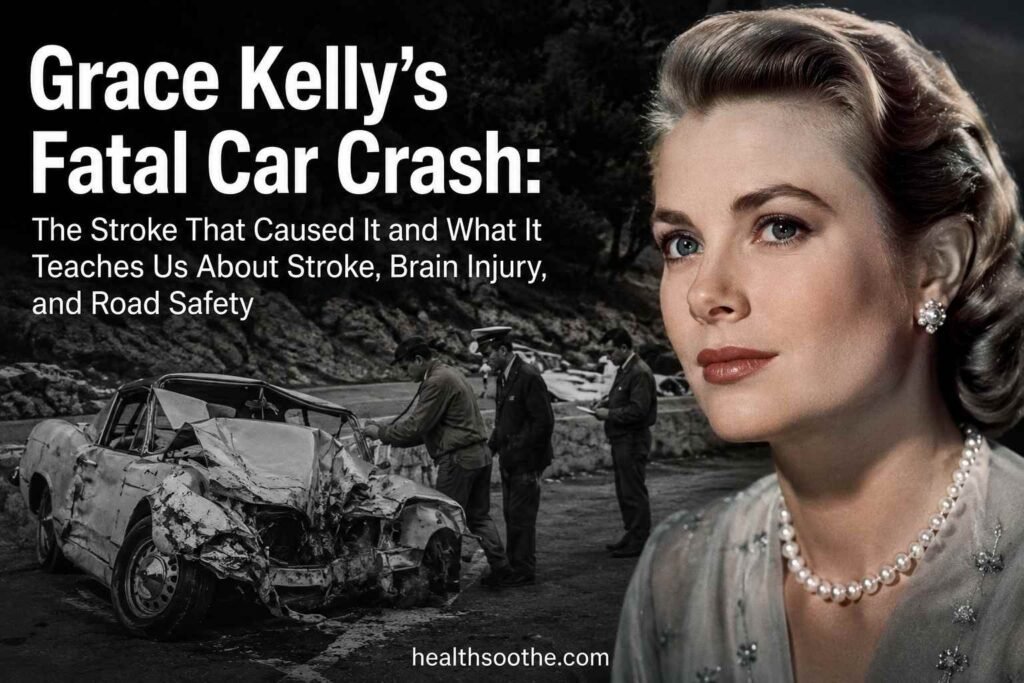
On the morning of September 13, 1982, Grace Kelly actress, Princess of Monaco, and one of the most recognisable women in the world got behind the wheel of a Rover 3500 on a winding mountain road above Monaco. She never reached her destination.
Medical investigators later concluded that Grace Kelly suffered a stroke while driving. The stroke caused her to lose consciousness at the wheel, the car broke through a retaining wall, and plummeted 120 feet down a cliff. She was placed on life support and declared brain dead the following day. She was 52 years old.
Her death was not simply a tragic accident. It was a medical emergency that unfolded at 60 miles per hour on a mountain road, and understanding what happened to her body that morning has genuine importance for anyone who wants to understand stroke, traumatic brain injury, and the devastating speed at which neurological emergencies can occur.
Related accident:
- Ryan Newman: Daytona 500 Crash: The Medical and Dental Trauma of High-Speed Racing Accidents
- Gordon Smiley 1982 Indianapolis Crash: What It Taught Us About Racing Safety and Head Trauma Prevention
Who Was Grace Kelly
Grace Patricia Kelly was born on November 12, 1929, in Philadelphia, Pennsylvania, into a prominent Irish-Catholic family. Her father Jack Kelly was a former Olympic gold medalist and successful construction contractor. From an early age Grace pursued acting with singular focus, training at the American Academy of Dramatic Arts in New York before making her Broadway debut in 1949.
Her film career was brief but remarkable. She won the Academy Award for Best Actress for her role in The Country Girl in 1955 and starred alongside Cary Grant and James Stewart in several critically acclaimed films. In 1956 she married Prince Rainier III of Monaco, stepping back from acting to become Princess of Monaco a role she held for 26 years until her death.
What Happened on September 13, 1982
Grace Kelly and her 17-year-old daughter Princess Stéphanie were preparing to travel from their family home in Roc Agel, France, to Paris, where Stéphanie was due to begin school. Their chauffeur brought the car around but with the quantity of luggage loaded into the back there was insufficient room for three people. Kelly insisted on driving herself rather than asking the chauffeur to make two trips.
The road from Roc Agel to Monaco is a narrow, winding mountain descent with multiple sharp bends and steep drops. It is a road that demands full attention and consistent braking through every corner.
Witnesses and subsequent medical investigation established that on one of those bends Grace Kelly suffered a sudden neurological event described initially as a minor stroke or transient ischaemic attack that caused her to lose consciousness briefly. The car, without driver input, continued forward, crossed the opposite lane, broke through a low retaining wall, and fell approximately 120 feet down the cliff face into a garden below.
Princess Stéphanie, seated beside her mother, attempted to reach the wheel but could not prevent the fall. Neither was wearing a seatbelt.
The Medical Events: What Happened to Grace Kelly’s Brain
Understanding the medical sequence of Grace Kelly’s death requires understanding two separate neurological events the stroke that caused the crash, and the traumatic brain injury sustained in the crash itself.
The initial stroke: what caused her to lose consciousness at the wheel
A stroke occurs when blood supply to part of the brain is interrupted either by a blood clot blocking an artery (ischaemic stroke) or by a blood vessel rupturing (haemorrhagic stroke). Within minutes of the blood supply being cut off, brain cells begin to die. The specific symptoms depend entirely on which part of the brain is affected.
In Grace Kelly’s case, the stroke affected regions of the brain controlling motor function and consciousness. She lost the ability to maintain control of the vehicle a process that in a stroke can happen within seconds of the event beginning.
Post-mortem examination confirmed that Kelly had suffered a cerebral haemorrhage a bleed within the brain itself before the crash occurred. This is distinct from the traumatic brain injury caused by the crash impact. The haemorrhage was already underway while she was driving.
Recognising stroke symptoms: the FAST test
Grace Kelly’s crash illustrates one of the most dangerous aspects of stroke: it can incapacitate without warning, in any setting, at any age. The FAST test is the internationally recognised method for identifying stroke symptoms quickly:
- F — Face: Has one side of the face dropped? Can the person smile normally?
- A — Arms: Can the person raise both arms and keep them raised? Does one arm drift downward?
- S — Speech: Is speech slurred, confused, or impossible to produce?
- T — Time: If any of these signs are present, call emergency services immediately. Every minute without treatment destroys approximately 1.9 million brain cells.
In a driving situation, sudden confusion, loss of coordination, or unexpected difficulty controlling the vehicle should be treated as a potential medical emergency for the driver and for every other road user nearby.
The traumatic brain injury from the crash impact
The 120-foot fall and subsequent impact caused severe traumatic brain injury on top of the existing cerebral haemorrhage. The combination of a pre-existing intracranial bleed and the additional trauma of a high-energy crash impact is among the most serious neurological scenarios in emergency medicine.
Grace Kelly was found unconscious in the back of the car she had been thrown from the front seat during the tumble. She was transported to Princess Grace Hospital in Monaco, where she was placed on life support. Brain imaging confirmed catastrophic damage to brain tissue from both the haemorrhage and the impact. She never regained consciousness.
On September 14, 1982. 24 hours after the crash her husband Prince Rainier III made the decision to withdraw life support. She was pronounced dead that afternoon.
Brain death: What it means medically?
Brain death is the complete and irreversible cessation of all brain function, including the brainstem, which controls breathing, heart rate, and all involuntary body functions. It is legally and medically equivalent to death in all major jurisdictions.
When a patient is declared brain dead, the brain has sustained damage so extensive that no recovery of any brain function is possible. A brain-dead patient on life support is being kept physiologically alive by machines the brain itself has permanently ceased to function. Grace Kelly’s declaration of brain death reflected the severity of the combined haemorrhagic stroke and crash trauma her brain had sustained.
The Daughter of Grace Kelly: Princess Stéphanie’s injuries — spinal fracture
Stéphanie survived the crash with a hairline fracture of the cervical spine a crack in one of the vertebrae of the neck. Cervical spine fractures are among the most serious injuries the body can sustain because of their proximity to the spinal cord. Damage to the spinal cord at the cervical level can cause paralysis from the neck down.
Stéphanie’s fracture was classified as stable meaning the bone had cracked but not displaced, and the spinal cord had not been compromised. This distinction between a stable and unstable spinal fracture is one of the critical assessments emergency responders make before moving a crash victim. Improper movement of an unstable cervical fracture can convert a survivable injury into permanent paralysis. Stéphanie’s recovery was complete, though the physical and psychological impact of surviving the crash that killed her mother stayed with her for decades.
The Oral Health Connection to Stroke
The connection between oral health and stroke risk is one of the most well-documented links in the mouth-body research literature and it is directly relevant to Grace Kelly’s story.
Multiple large-scale studies have established that periodontal disease, chronic gum infection increases the risk of stroke. The bacteria from infected gums enter the bloodstream through the inflamed gum tissue, went to the blood vessels of the brain, and contribute to the arterial inflammation and clot formation that trigger ischaemic strokes. Patients with severe periodontal disease have been shown to have a 2–3 times higher risk of stroke compared to patients with healthy gums.
This does not mean gum disease caused Grace Kelly’s stroke her haemorrhagic stroke had a different mechanism. But it illustrates the broader point that oral health is not separate from brain health.
Practical steps that reduce both gum disease and associated stroke risk include:
- Brushing twice daily with fluoride toothpaste, ensure you cleaned your gum line thoroughly
- Flossing daily to remove plaque from between teeth where brushing cannot reach
- Professional dental cleaning every six months to remove calcified tartar that home cleaning cannot clean.
- Treating gum disease actively rather than ignoring bleeding gums. Gums bleeding are not normal and should always prompt a dental visit.
- Managing systemic conditions like diabetes and hypertension that accelerate both gum disease and stroke risk.
What to Do If a Driver Shows Signs of a Medical Emergency
Grace Kelly’s crash raises a practical safety question that is rarely discussed: what should a passenger do if the driver suffers a sudden medical emergency at the wheel?
- Stay calm and do not grab the wheel sharply a sudden jerk of the wheel at speed can cause an immediate loss of control
- Speak clearly and firmly to the driver if they are having a seizure or stroke, verbal commands may not be effective but should be attempted
- If the driver is unresponsive, apply steady steering pressure to guide the vehicle toward the kerb or a safe stopping area avoid overcorrecting
- Apply the handbrake gradually if the vehicle needs to be stopped sudden handbrake application at speed causes rear wheel lockup and potential spin
- Once stopped, call emergency services immediately a medical emergency at the wheel is a 999/911 call, not a situation to manage alone
- Do not move the driver unless the vehicle is on fire suspected stroke and spinal injury both require professional extraction
Grace Kelly’s Legacy
Grace Kelly remains one of the most celebrated figures of twentieth century Hollywood and European royalty. Her death at 52 sudden, preventable in the sense that a recognised medical emergency at the wheel is among the most dangerous situations on any road shocked the world precisely because it was so unexpected.
The medical realities of her death stroke, traumatic brain injury, brain death, spinal fracture are not footnotes to a celebrity story. They are the story.
Understanding them, and understanding the oral and cardiovascular health factors that affect stroke risk, is the most meaningful way to honour what her death can still teach us forty years later.
