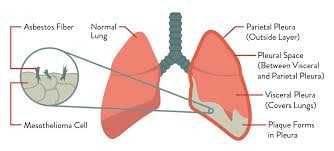
A mesothelioma is a rare form of cancer that affects the cells that make up the mesothelium. The mesothelium is the lining or membrane that covers and protects various internal organs of the body. The mesothelium is composed of two layers of specialized cells known as mesothelial cells. One layer directly surrounds an organ; the other forms a protective sac around thoracic and peritoneal organs.
The most common form of mesothelioma affects the pleura, which is the membrane or sac that lines the lungs and chest cavity. Other, rarer types of mesothelioma affect tissue in the abdomen (peritoneal mesothelioma), around the heart and around the testicles.
Mesothelioma doesn’t include a form of noncancerous (benign) tumor that occurs in the chest and is sometimes called benign mesothelioma or solitary fibrous tumor.
Mesothelioma is an aggressive and deadly form of cancer. Mesothelioma treatments are available, but for many people with mesothelioma, a cure is not possible. Symptoms of mesothelioma may not appear until up to 30 to 50 years after initial exposure to asbestos.
However, after symptoms become apparent, mesothelioma may rapidly progress to cause life-threatening complications.
In 2015, the fatality rate for mesothelioma in the United States (U.S.) was 10.93 per million people. Only 9 percent of those diagnosed with mesothelioma live longer than 5 years.
The term “cancer” refers to a group of diseases characterized by abnormal, uncontrolled cellular growth (e.g., mesothelial cells) that invades surrounding tissues and may spread (metastasize) to distant bodily tissues or organs via the bloodstream, the lymphatic system, or other means. Different forms of cancer, including mesothelioma, may be classified based upon the cell type involved, the specific nature of the malignancy, the tissues or organs affected, and the disease’s clinical course. Symptoms of mesothelioma vary depending upon the location, type, and stage of cancer.
Mesothelioma Health Resources
Approximately 70 to 90% of cases of mesothelioma result from exposure to asbestos. Symptoms of mesothelioma may not appear until up to 30 to 50 years after initial exposure to asbestos. However, after symptoms become apparent, mesothelioma may rapidly progress to cause life-threatening complications.
American Cancer Society, Inc.
250 Williams NW St
Ste 6000
Atlanta, GA 30303
USA
Tel: (404)320-3333
Tel: (800)227-2345
TDD: (866)228-4327
website:: http://www.cancer.org
American Lung Association
1301 Pennsylvania Ave NW
Suite 800
Washington, DC 20004
USA
Tel: (202)785-3355
Fax: (202)452-1805
Tel: (800)586-4872
Email: info@lungusa.org
Website: http://www.lungusa.org
National Cancer Institute
6116 Executive Blvd Suite 300
Bethesda, MD 20892-8322
USA
Tel: (301)435-3848
Tel: (800)422-6237
TDD: (800)332-8615
Email: cancergovstaff@mail.nih.gov
Website: http://www.cancer.gov
PMP Pals’ Network
P.O. Box 6484
Salinas, CA 93912
Tel: (831)424-4545
Fax: (831)424-4545
Email: pmppals@yahoo.com
Website: http://www.pmppals.org
Canadian Cancer Society
55 St. Clair Avenue West Suite 500
Toronto, M4V 2Y7
Canada
Tel: 4164885400
Fax: 4164882872
Tel: 8002688874
Email: webmaster@ontario.cancer.ca
Internet: http://www.cancer.ca/
Cancer Care, Inc.
275 Seventh Avenue
New York, NY 10001
Tel: (212)712-8400
Fax: (212)719-0263
Tel: (800)813-4673
Email: info@cancercare.org
Website: http://www.cancercare.org
Mesothelioma Applied Research Foundation, Inc.
1317 King Street
Alexandria, VA 22314
USA
Tel: (805)563-8400
Fax: (805)563-8411
Tel: (877)363-6376
Email: info@curemeso.org
Website: http://www.curemeso.org
Rare Cancer Alliance
1649 North Pacana Way
Green Valley, AZ 85614
USA
Website: http://www.rare-cancer.org
Genetic and Rare Diseases (GARD) Information Center
PO Box 8126
Gaithersburg, MD 20898-8126
Tel: (301)251-4925
Fax: (301)251-4911
Tel: (888)205-2311
TDD: (888)205-3223
Website: http://rarediseases.info.nih.gov/GARD/
Asbestos Disease Awareness Organization
1525 Aviation Boulevard Suite 318
Redondo Beach, CA 90278
Tel: (310)251-7477
Fax: (866)294-1550
Email: info@AsbestosDiseaseAwareness.org
Website: http://www.asbestosdiseaseawareness.org
Friends of Cancer Research
1800 M Street NW
Suite 1050 South
Washington, DC 22202
Tel: (202)944-6700
Email: info@focr.org
Internet: http://www.focr.org
Cancer.Net
American Society of Clinical Oncology
2318 Mill Road Suite 800
Alexandria, VA 22314
Tel: (571)483-1780
Fax: (571)366-9537
Tel: (888)651-3038
Email: contactus@cancer.net
Website: http://www.cancer.net/
Cancer Support Community
1050 17th St NW Suite 500
Washington, DC 20036
Tel: (202)659-9709
Fax: (202)974-7999
Tel: (888)793-9355
Website: https://www.cancersupportcommunity.org/
Nigerian Cancer Society
No 26 Oluwunmi Crescent
Off Alex Ekwueme Way
Kado estate (by Kado Police Station)
Abuja
E-mail: cancernig@gmail.com
Facebook: https://www.facebook.com/Nigerian-Cancer-Society
Twitter: @NigCancer
Website: www.cancerng.org/
Society of Oncology and Cancer Research of Nigeria (SOCRON)
SOCRON OFFICE
102 Bashorun Road, Ashi, Ibadan.
P.O. Box 29822, Secretariat Post Office,
Ibadan, Oyo State, Nigeria
Telephone:(+234)027512634
FAX:(+234)027512634
E-mail:organizingsec@socron.net
E-mail:info@socron.net
website: http://www.socron.net/
Common Sleep Issues Associated With Cancer | Tuck sleep
Tuck Sleep is a community devoted to improving sleep hygiene, health and wellness through the creation and dissemination of comprehensive, unbiased, free web-based resources. Tuck has been referenced by Well + Good, Shape, Smithsonian Magazine, Harvard University and by many sleep organizations across the web.
TUCK OFFICE
PO Box 61293
Seattle, WA 98141-6293
E-mail: kayla@tuck.com
website: https://www.tuck.com/
Drug Dangers
Drug Dangers keep the public educated and informed of all defective medical devices and dangerous medications that are currently on the market. As an online resource sponsored by Seeger Weiss LLP, Drug Dangers strives to provide accurate, relevant medical information all in one place.
DANGEROUS DRUG AND DEVICES
EMAIL: info@drugdangers.com
TELEPHONE: 1-888-443-7024
Address: 77 Water Street 8th Floor New York, NY 10005
Website:https://www.drugdangers.com/
Mesothelioma Justice Network
1330 Boylston Street, Suite 400
Chestnut Hill, MA 02467
Tel: (888) 360-4215
Email: brittney@asbestos.net
Website: https://www.asbestos.net/legal/compensation/
Useful Cancer Links
- www.uicc.org
- www.livestrong.org
- www.inctr.org
- www.asco.org
For a Complete Report of Mesothelioma cancer links
This is an abstract of a report from the National Organization for Rare Disorders (NORD). A copy of the complete report can be downloaded free from the NORD website. The complete report contains additional information including symptoms, causes, affected population, related disorders, standard and investigational therapies (if available), and references from medical literature.
The information provided in this article report is not intended for diagnostic purposes. It is provided for informational purposes only. NORD recommends that affected individuals seek the advice or counsel of their own personal physicians.
This disease entry is based upon medical information available through the date at the end of the topic. Since NORD’s resources are limited, it is not possible to keep every entry in the Rare Disease Database completely current and accurate. Please check with the agencies listed in the Resources section for the most current information about this disorder.
For additional information and assistance about rare disorders and mesothelioma and cancer resources, please contact the National Organization for Rare Disorders at P.O. Box 1968, Danbury, CT 06813-1968; phone (203) 744-0100; website: www.rarediseases.org or email: orphan@rarediseases.org
© All rights reserved healthsoothe.com. No part of this health information may be reproduced by any means without permission in writing from the publisher. Copyright 2004, 2006, 2014 National Organization for Rare Disorders, Inc.
Healthsoothe Medical Reference from the National Organization for Rare Disorders
RELATED READING