
Close Menu
  • Healthy
    • Skin & Body Care
    • Weight and Fitness
    • Mental Health
    • Medications Drug Information
    • Conditions Syndromes
    • Pill Capsule Identification
    • Medication Safety
    • Drug Interactions
  • Dental Care
    • Dental Procedures And Treatments
    • Dental Costs and Insurance
    • Pediatric Dental Care
    • TMJ Jaw Health
    • Dental Product Reviews
    • Dental instruments
  • Health Tools
    • Body Tat Calc
    • CALC Diet Calorie
    • Ideal Body Weight Calc
    • Burned Calories Calc
    • View All
  • Nutrition
  • Connect
    • About us
    • Contact us
  • Submit Product
Facebook X (Twitter) Instagram
Healthsoothe: Our Wellbeing
Homepage - Dental instruments and equipment - Metzenbaum vs Mayo Scissors: Key Differences

Metzenbaum vs Mayo Scissors: Key Differences

Isreal Olabanji DST, RNIsreal Olabanji DST, RNUpdated:July 25, 2026
Share the Knowledge. Spread the Wellness! Facebook Twitter Pinterest LinkedIn Reddit WhatsApp
Follow Us
Add as Preferred on Google Facebook Instagram Pinterest

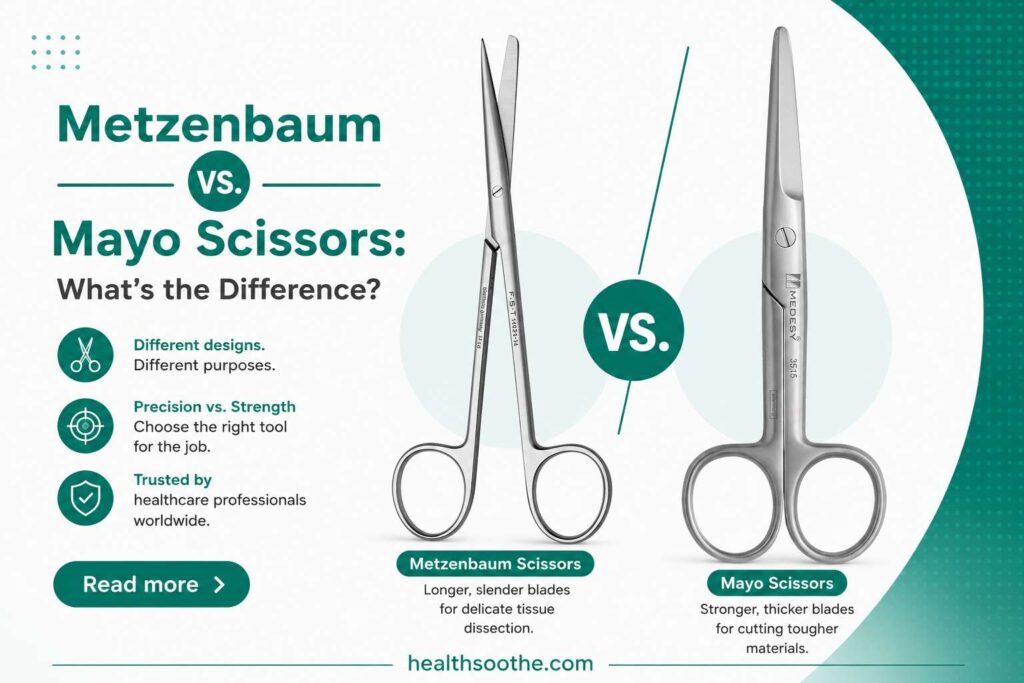
Pick up a pair of Metzenbaum scissors next to a pair of Mayo scissors, and at first glance they look like close cousins. Both have blunt tips and finger-ring handles, and both show up in nearly every surgical tray in the country. But hand the wrong pair to a surgeon mid-procedure, and the difference becomes obvious fast. One is built for soft, fine tissue. The other is built to muscle through tougher material.

Here’s a clear, side-by-side look at what separates Metzenbaum scissors from Mayo scissors, what each one is actually built to cut, and how the curved and straight versions of each get used.

Related Topic:

  • Walsham Forceps vs. Asch Forceps: Whats the Difference?
Jump to What You Need
  1. What Are Metzenbaum Scissors?
  2. What Are Mayo Scissors?
  3. Metzenbaum vs. Mayo: Side by Side
  4. Straight vs. Curved: Does the Shape Matter?
  5. Which One Should You Use?
  6. Conclusion

What Are Metzenbaum Scissors?

Metzenbaum scissors, often just called “Metz” in the OR, have long, thin blades attached to a shorter shank. That long blade-to-shank ratio is what makes them so useful for reaching into deep, narrow spaces in the body without much bulk getting in the way.

They’re built for blunt dissection and cutting fine, soft tissue, not for muscling through anything dense. You’ll find them in:

  • Plastic surgery, for precise, low-trauma incisions
  • Neurosurgery, for separating blood vessels and removing fine tissue around delicate structures
  • Ophthalmic procedures, where a single wrong cut can damage critical structures nearby
  • Vascular surgery, for separating vessels and clearing a path for sutures or grafts

Surgeons also reach for Metzenbaum scissors during procedures that call for cutting through the deep rib bed lining without puncturing the lung cavity behind it, a task where the thin blades and careful control really pay off. Common versions include straight delicate, curved, and supercut models with tungsten carbide inserts for a sharper, longer-lasting edge.

What Are Mayo Scissors?

Mayo scissors are heavier and sturdier, with wider blades and a nearly equal blade-to-shank length. That extra bulk gives them the leverage needed to cut through tissue that would dull or bend a thinner blade.

They’re the tool of choice whenever the job calls for cutting through something tough rather than gently separating something fine. That includes:

  • Cutting sutures, which is so common that Mayo scissors are sometimes just called “suture scissors”
  • Gynecological procedures, for cutting the outer wall of the uterus or dissecting tendons
  • Orthopedic surgery, for cutting dense connective tissue
  • Urological procedures, including prostatectomies, where tougher tissue needs to be cut cleanly

Mayo scissors also show up regularly in thyroidectomies and laryngectomies for cutting ligaments, and they’re a standard part of the tray in general procedures like hernia repair, appendectomy, mastectomy, and exploratory abdominal surgery.

Metzenbaum vs. Mayo: Side by Side

FeatureMetzenbaum ScissorsMayo Scissors
Blade shapeThin, narrow bladesWider, heavier blades
Blade-to-shank ratioLong blades, shorter shankBlades and shank closer to equal length
Built forSoft, delicate tissueTough, dense tissue and sutures
Typical length5 to 9 inches5.5 to 9 inches
Common specialtiesPlastic surgery, neurosurgery, ophthalmology, vascular surgeryGeneral surgery, orthopedics, OB/GYN, urology
Nickname“Metz”Sometimes called “suture scissors”


Straight vs. Curved: Does the Shape Matter?

Both Metzenbaum and Mayo scissors come in straight and curved versions, and the choice between them depends on where in the body the surgeon is working.

Straight blades work best on or near the surface, cutting along a flat plane like skin, sutures, or surface-level tissue. Because the blade lines up directly with the surgeon’s hand and line of sight, straight scissors allow for more direct force and a cleaner, more controlled cut on flat surfaces.

Curved blades are built for going deeper. The curve lets the surgeon work around structures instead of straight through them, which makes a real difference when cutting inside a body cavity or navigating tissue planes that aren’t flat. Curved scissors also tend to give a clearer view of the surgical field, since the surgeon’s hand and the shank sit slightly out of the direct line of sight.

Which One Should You Use?

If the tissue is fine, soft, or sits near something you cannot afford to nick, reach for Metzenbaum scissors. The thin blades and long reach are built for control, not force.

You May Also Like
  • Basal Cell Carcinoma vs. Squamous Cell Carcinoma: Key Differences
  • DMD vs DDS: Key Differences, Benefits, and Applications Explained
  • Mp 447 Vs AdderallMP 447 Pill vs. Adderall: Key Differences and Which Medication is Better for You

If you’re cutting something with real resistance, like a suture, tendon, or dense connective tissue, Mayo scissors are the better fit. Trying to force tough tissue through a pair of Metzenbaum scissors will only dull the blades and make for a rougher cut. Most operating rooms keep both on the tray, since a single procedure often needs each tool at a different point.

Conclusion

Metzenbaum and Mayo scissors aren’t competing for the same job. One is built for precision on delicate tissue, and the other is built for strength on tougher material. Knowing the difference, and knowing when to use the curved versus straight version of each, is a basic skill that pays off in cleaner cuts, fewer complications, and a smoother procedure from start to finish.

How useful was this post?

Click on a star to rate it!

Average rating 0 / 5. Vote count: 0

No votes so far! Be the first to rate this post.

We are sorry that this post was not useful for you!

Let us improve this post!

Tell us how we can improve this post?

Editorial Policy: HealthSoothe is dedicated to providing evidence-based, actionable wellness content. Every piece of content or review on our platform is cross-referenced with peer-reviewed medical journals and verified by certified healthcare professionals before publication.

Written by: Isreal Olabanji, certified Dental Nurse (DST, RN).

This article cannot diagnose your problem. A dentist needs to examine you. If you have facial swelling, fever, or difficulty breathing or swallowing, go to an emergency department right away.

Add as Preferred on Google Follow on Facebook Follow on Instagram Follow on Pinterest
Share. Facebook Twitter Pinterest LinkedIn Tumblr Email Reddit WhatsApp
Isreal Olabanji DST, RN
  • Website
  • Facebook
  • X (Twitter)
  • Pinterest
  • Instagram
  • LinkedIn

Isreal Olabanji is a certified Dental Nurse (DST, RN) in Nigeria with a background in pharmacy, anatomy, and physiology. His hands-on clinical experience includes pharmacy and family planning services at the 32 Artillery Brigade clinic, Owena Cantonment, Akure (2012), dental surgery assistance at the State Specialist Hospital, Oke-Aro, Akure (2013) and the State Specialist Hospital, Ikare-Akoko (2014), and work as a dental assistant at the Federal Medical Centre, Owo (2016). Drawing on this experience in patient care, oral health education, public health, and dental instruments, he writes evidence-based dental and oral health content for readers in Nigeria, the United States, and beyond. Follow Isreal on Twitter, Facebook, Instagram, TikTok, Pinterest, or LinkedIn.

Add A Comment
Leave A Reply

You must be logged in to post a comment.

Explore Health Calculator

Clinician-Informed Diagnostics

Available ToolsAction
Oral Health Risk AnalyzerCheck Risk
Dental Infection Severity ScaleRate Severity
Dental Cost & Insurance EstimatorEstimate
Page
  • About Healthsoothe
  • Contact us
  • Privacy & Affiliate Disclosure
  • Advertise
  • Blog
  • Become a Consulting Dental Nurse in Nigeria
  • Become a Consulting Pharmacist in Nigeria
  • Become a Consulting Doctor or Dentist
  • Sitemap: Easy Access
Free Health calc
  • BMI & Oral Health Risk Calculator
  • Dental Cost Estimator Calculator
  • Dental Student Practical Calculator
  • FREE Body Fat Calculator for Men and Women | Calculate your Body Fat Using 7 Different Methods
  • Free Dental Infection Severity Calculator
  • Free Oral Health Risk Calculator — Find Your Risk Level
  • Online Calculator Of Golden Ratio Face
Product Reviews
  • Submit a Product
  • Review Policy
  • Brand Partnerships
  • Review Methodology
© 2026 Isreal Olabanji Services World LLC Healthsoothe.com. All rights reserved. Healthsoothe is a registered trademark of Isreal Olabanji Services World LLC. Disclaimer: Statements made, or products sold through this website, have not been evaluated by the United States Food and Drug Administration. Also, National Agency for Food and Drug Administration and Control. They are not intended to diagnose, treat, cure or prevent any disease. Please note that Isreal Olabanji Services World LLC is not affiliated with, or in any way related to, websites that are not specifically Healthsoothe.com. Isreal Olabanji Services World LLC. is not responsible or liable for products sold or shipped from unauthorised sources.

Type above and press Enter to search. Press Esc to cancel.

We value your privacy

We use cookies for Google Analytics and for advertising that helps support Healthsoothe. You can accept or reject them. Rejecting will not affect your use of the site. You can change your choice at any time. See our Privacy Policy.

WhatsApp us