
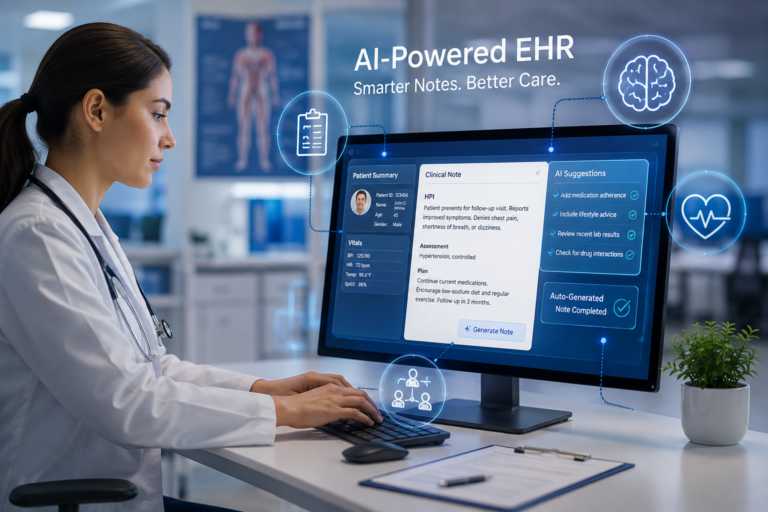
Medical workers devote large parts of daily work to recording patient visits. Though precise clinical notes stay vital for good care, rules, and payment, typing data by hand steals time needed for face-to-face contact. Constant copying and pasting tasks, moving among programs, and finishing standard forms may raise chances for errors and doctor exhaustion too.
Artificial intelligence (AI) aids in reshaping this process via smarter electronic health record integration. Instead of replacing healthcare workers, AI helps them by automating repetitive documentation duties, organizing clinical data, and boosting workflow efficiency. Since healthcare entities keep adopting digital options, AI-driven EHR integration turns into a vital instrument for streamlining documentation throughout various medical fields.
Advantages go beyond just saving time. Improved document flows may boost record precision, cut admin loads, aid clinical decisions, and make things easier for staff and patients. If used carefully, artificial intelligence lets medical groups spend extra hours giving treatment and fewer hours handling papers.
Medical systems now see how good notes aid teamwork between groups. Uniform files, quicker data exchange, and less repetition let doctors find what they want fast while keeping things steady during the whole patient trip.
With healthcare entities keeping digital offerings growing, record-keeping speed now stands as a major concern. Doctors must handle rising numbers of patients yet still keep correct and quick files. Using artificial intelligence within electronic health records helps meet these needs by reducing tedious office tasks, allowing providers to focus more on medical duties without compromising document quality.
How AI EHR Integration Simplifies Clinical Documentation
Reduce Manual Data Entry
Automation minimizes repetitive administrative work.
AI-powered EHR systems can automatically gather pertinent clinical data, complete documentation sections, and organize patient files without requiring doctors to repeatedly type the same information. Cutting down on typing work saves time while reducing the chance of record mistakes.
Automation improves workflow efficiency.
Support Multiple Medical Specialties
Different specialties require different documentation approaches.
Integration of AI enables the adaptation of documentation workflows across primary care, cardiology, orthopedics, dermatology, emergency medicine, and numerous other specialties. Templates specific to specialties and intelligent documentation assistance aid clinicians in keeping full and pertinent patient records without depending on repetitive copy-paste techniques.
Specialty-focused workflows improve documentation quality.
Improve Clinical Accuracy
Accurate documentation supports better patient care.
AI helps organize patient history data, spot missing details, and aid clinicians in keeping documentation uniform during every single visit. Using a structured clinical note template powered by AI ensures that more organized files boost provider communication levels while backing up smart clinical choices made daily.
Accurate records strengthen care coordination.
Reduce Administrative Burden
Administrative tasks contribute significantly to clinician workload.
Automating documentation, organizing medical records, and streamlining routine workflows enable healthcare professionals to spend less time finishing paperwork. That extra time may be directed toward patient care, collaboration, and clinical decision-making.
Reduced administrative work supports provider efficiency.
Strengthen Care Team Collaboration
Shared information improves coordinated care.
Combined EHR platforms enable doctors, nurses, experts, and admin groups to access fresh medical data with greater speed. Uniform record-keeping cuts down on messaging errors while aiding improved teamwork within various healthcare environments.
Better cooperation likewise aids easier patient moves across various hospital units and medical fields. If clinical data gets refreshed regularly and distributed instantly, medical groups can reach superior choices while cutting down needless holdups, repeated paperwork, and messaging voids during the whole treatment path.
Connected teams improve patient outcomes.
Enhance Compliance and Documentation Consistency
Consistent documentation supports regulatory requirements.
AI-assisted documentation aids in standardizing clinical records, improving completeness, and reducing inconsistencies within patient files. Standardized documentation further supports coding accuracy, reporting needs, and organizational quality programs.
Consistency strengthens documentation quality.
Support Continuous Workflow Improvement
Healthcare technology continues to evolve.
Entities may examine document formats, locate process blockages, and polish machine-aided routines with time. Ongoing assessment aids medical staff in enhancing speed while modifying record habits to shifting clinical and legal demands.
Ongoing optimization supports long-term performance.
Final Thoughts
AI-powered EHR integration moves clinical documentation past repetitive copy-paste workflows by improving efficiency, accuracy, and collaboration across healthcare specialties. Automating routine documentation tasks, reducing administrative workloads, supporting specialty-specific workflows, and strengthening communication let healthcare professionals focus more on delivering quality patient care.
Entities that effectively merge AI with current EHR platforms frequently gain advantages beyond simple documentation speed. Uniform medical files, better communication among staff groups, and smoother processes aid in making a steadier health encounter while backing up lasting work gains throughout the whole company.
As health systems keep investing in digital changes, AI-assisted note-taking will become key to making clinic work faster. Careful addition does more than improve note quality; it helps doctors feel good, makes teams communicate better, and yields better results for patients across many medical fields.