
Most people don’t look closely at their moles until something already looks obviously wrong. By then, you’ve lost the exact advantage that makes melanoma one of the most treatable cancers in the world: catching it early. When melanoma is found while it’s still confined to the top layer of skin, the five-year survival rate is around 99%. Once it’s spread to distant parts of the body, that number drops sharply. The difference between those two outcomes usually comes down to one thing: whether someone noticed a change early enough to act on it.
The ABCDE rule for melanoma is the tool dermatologists teach patients to make that noticing easier. According to Cleveland Clinic, it’s simple enough to run through in under a minute per mole, and it’s specific enough to catch the features that separate an ordinary mole from a dangerous one.
What the ABCDE Rule for Melanoma Actually Means
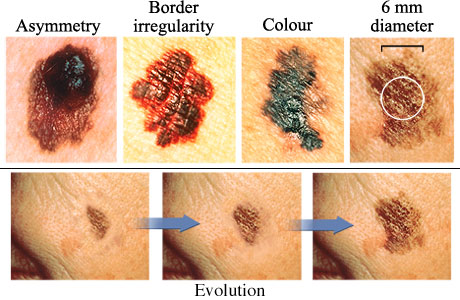
A is for Asymmetry. Draw an imaginary line through the middle of a mole. On a normal mole, both halves should look roughly like mirror images of each other. On a melanoma, they usually don’t. One half might be a different shape, size, or thickness than the other.
B is for Border. Healthy moles tend to have a smooth, even edge. Watch for borders that are ragged, notched, blurred, or scalloped. If you could trace the edge of the mole with a steady hand versus one that keeps jumping in and out, an irregular border leans toward the second.
C is for Color. A normal mole is usually one consistent shade of brown. Melanomas often contain a mix of colors within a single spot, tan, brown, black, and sometimes patches of red, white, or blue. Uneven color distribution within the same mole is a stronger warning sign than the color itself.
D is for Diameter. Dermatologists generally flag anything larger than 6 millimeters, roughly the size of a pencil eraser, though melanomas are increasingly being caught smaller than that. Size alone isn’t a reliable red flag, but a mole that’s noticeably larger than your others is worth a closer look.
E is for Evolving. This is the letter that gets added most recently to the original rule, and many dermatologists now consider it the most important one. Evolving means any change over time: a mole that’s growing, changing shape, changing color, becoming raised, or developing new symptoms like itching, bleeding, or crusting. A mole that passes every other test but is clearly different from how it looked six months ago still deserves attention.
The “Ugly Duckling” Sign: A Useful Add-On
Most people have moles that share a family resemblance. Your moles probably look broadly similar to each other in color, size, and shape, since they’re all reacting to the same skin and sun history. The “ugly duckling” sign is based on a simple idea: if one mole looks distinctly different from all your others, it’s worth flagging even if it technically passes the ABCDE checklist.
This matters because it catches outliers the ABCDE rule can miss. A mole doesn’t need to fail every letter to be suspicious. Sometimes it just needs to look like it doesn’t belong.
Some dermatologists now teach an extended version, ABCDEF, adding “F” for funny-looking, which is really just the ugly duckling concept folded into the same checklist. If you want one rule to remember, treat “does this look like it belongs with the rest of my moles” as your sixth question.
Where the ABCDE Rule for Melanoma Falls Short
No self-exam method catches everything, and it’s worth knowing where this one has blind spots.
Nodular melanoma, a fast-growing form, often doesn’t fit the ABCDE pattern at all. It tends to be symmetrical, evenly colored, and round, the opposite of what the checklist teaches you to look for. Its warning sign is usually just rapid growth and a firm, raised bump rather than color or border changes.
Amelanotic melanoma can appear pink, red, or skin-colored instead of the brown or black most people associate with skin cancer, which makes the “C” almost useless as a filter.
And if you have brown or Black skin, the most common form of melanoma you’re at risk for, acral lentiginous melanoma, develops on the palms, soles, and under the nails rather than in typical mole locations, and it’s frequently missed because neither the ABCDE rule nor most self-exam habits are built around checking those areas. We cover this in detail in our guide to skin cancer on black skin, including exactly what to look for under your nails and on your palms and soles.
The takeaway isn’t that the ABCDE rule for melanoma is unreliable. It’s that ABCDE plus the ugly duckling sign plus a habit of noticing anything unusual, anywhere, gives you far better coverage than any single rule on its own.
How to Do a Full Skin Self-Exam
A proper self-exam using the ABCDE rule for melanoma takes about ten minutes once you know the routine. Do this once a month, ideally in a well-lit room with a full-length mirror and a hand mirror for spots you can’t see directly.
- Face the mirror. Check your face, ears, neck, chest, and stomach.
- Raise your arms. Examine both sides of your body, armpits included.
- Check your arms and hands. Look at your forearms, upper arms, palms, and between each finger.
- Sit down and examine your legs. Cover your thighs, shins, calves, ankles, and the tops and soles of your feet, including between your toes.
- Use the hand mirror for your back. Check your neck, shoulders, upper back, and lower back. Ask a partner or family member to help if you can’t get a clear view.
- Check your scalp. Part your hair in sections, or use a blow dryer on a cool setting to move hair aside as you go.
- Don’t skip your nails. Look at every fingernail and toenail for new dark streaks or discoloration.
Take a photo of any mole you’re unsure about. A photo dated and saved on your phone gives you an objective way to check for the “E” in ABCDE a month later, since memory alone is an unreliable way to judge whether something has actually changed.
When to See a Dermatologist
Book an appointment if you notice:
- A mole that fails two or more ABCDE criteria, especially asymmetry combined with an irregular border
- Any single mole that looks distinctly different from the rest of your moles
- A new dark streak under a nail with no injury to explain it
- A sore or spot that hasn’t healed within a few weeks
- Any mole that’s changed noticeably since your last self-exam
Not every flagged mole turns out to be melanoma, and that’s the point of a professional evaluation rather than self-diagnosis. If you haven’t done a full skin self-exam recently, our complete guide covers what happens during a dermatologist visit, when a biopsy is needed, and how each diagnostic method works.
FAQs
What does the E in ABCDE stand for? Evolving. It refers to any mole that’s changing in size, shape, color, elevation, or that’s developed new symptoms like itching, bleeding, or crusting. Many dermatologists consider it the single most reliable warning sign in the ABCDE rule for melanoma, since it can catch melanomas that don’t display the other four features.
How often should I do a skin self-exam? Once a month is the standard recommendation. Doing it more often than that rarely adds value, since most changes worth catching develop over weeks or months, not days.
Can a mole be melanoma if it doesn’t meet any ABCDE criteria? Yes. Nodular melanoma and amelanotic melanoma often look symmetrical, evenly colored, and unremarkable by ABCDE standards. This is why the “ugly duckling” sign and simply trusting that something looks off are useful backups to the checklist.
Is a mole automatically melanoma if it fails one ABCDE criterion? No. Plenty of harmless moles are naturally a bit asymmetrical or have an uneven border. The concern grows when a mole fails multiple criteria at once, or when it’s clearly evolving over time. When in doubt, have a dermatologist look at it rather than trying to self-diagnose from the checklist alone.